Explanatory Report
Article 13 – Interventions on the human genome See the Addendum
89.
The progress of science, in particular in knowledge of the human genome
and its application, has raised very positive perspectives, but also
questions and even great fears.
Whilst developments in this field may
lead to great benefit for humanity, misuse of these developments may
endanger not only the individual but the species itself. The ultimate
fear is of intentional modification of the human genome so as to produce
individuals or entire groups endowed with particular characteristics
and required qualities. In Article 13, the Convention provides the
answer to these fears in several ways.
90.
In every case, any intervention which aims to modify the human genome
must be carriedout for preventive, diagnostic or therapeutic purposes.
Interventions aimed at modifying geneticcharacteristics not related to a
disease or to an ailment are prohibited. As long as somatic cell
gene therapy is currently at the research stage, its application can be
allowed only if it complies with the standards of protection provided
for in Article 15 and the following Articles.
91.
Interventions seeking to introduce any modification in the genome of
any descendants are prohibited. Consequently, in particular genetic
modifications of spermatozoa or ova for fertilisation are not allowed.
Medical research aiming to introduce genetic modifications in
spermatozoa or ova which are not for procreation is only permissible if
carried out in vitro with the approval of the appropriate ethical or
regulatory body.
92. On the other
hand the article does not rule out interventions for a somatic purpose
which might have unwanted side-effects on the germ cell line. Such may
be the case, for example, for certain treatments of cancer by
radiotherapy or chemotherapy, which may affect the reproductive system
of the person undergoing the treatment.
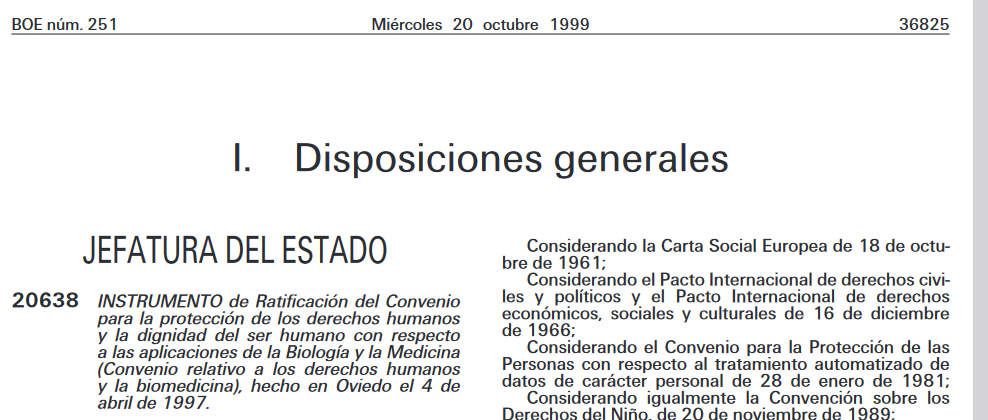
Artículo 15. Regla general.
La investigación científica en el ámbito de
la biología y la medicina se efectuará libremente, a reserva de lo
dispuesto en el presente Convenio y en otras disposiciones jurídicas que
garanticen la protección del ser humano.
Artículo 16. Protección de las personas que se presten a un experimento.
No podrá hacerse ningún experimento con una persona, a menos que se den las siguientes condiciones:
i) Que no exista un método alternativo al experimento con seres humanos de eficacia comparable.
ii) Que los riesgos en que pueda incurrir la
persona no sean desproporcionados con respecto a los beneficios
potenciales del experimento.
iii) Que el proyecto de experimento haya sido
aprobado por la autoridad competente después de haber efectuado un
estudio independiente acerca de su pertinencia científica, comprendida
una evaluación de la importancia del objeto del experimento, así como un
estudio multidisciplinar de su aceptabilidad en el plano ético.
iv) Que la persona que se preste a un
experimento esté informada de sus derechos y las garantías que la ley
prevé para su protección.
v) Que el consentimiento a que se refiere el
artículo 5 se haya otorgado expresa y específicamente y esté consignado
por escrito. Este consentimiento podrá ser libremente retirado en
cualquier momento.
https://www.boe.es/buscar/doc.php?id=BOE-A-1999-20638
"Marcel de Graaff
Request for the direct suspension of marketing authorizations
Brussels, 4 October 2023
In
response to the COVID-19 pandemic,a new Regulation was hastily
introduced and became effective on July 18, 2020 (refer to Article 5).
The key provisions of significance are found in Articles 2(1) together with (2) and 4(1) of Regulation 2020/1043/EU.
This regulation pertains to the conduct of clinical trials involving
medicinal products designed for human use that contain or consist of
genetically modified organisms and are intended for the treatment or
prevention of coronavirus disease (COVID-19), as well as the supply of
such medicinal products


This Regulation allowed for a temporary derogation from the very strict rules of Directive 2001/18/EC
(...)
Regulation
2020/1043/EU is void because it is not based on the correct legal
basis. Articles 114 or 168(4)(c) of the Treaty on the Functioning of the
European Union (TFEU) cannot be invoked in this case. This means that
the rules of Directive 2001/18/EC continued to apply in full and that a
technical dossier and an environmental report should therefore have been
submitted. Having failed to do so, all the permits issued were thus unlawfully granted to the pharmaceutical companies.
(...)
The recommendations for categorisation and interpretation of the law is reflected in the EMA's guidelines.
Reflection paper on classification of advanced therapy medicinal products 2015
According to this paper, and especially paragraph 2.3.3, mRNA is considered an example of gene
therapy.
( 2.3.3. Gene therapy medicinal product versus cell therapy medicinal product
Another borderline scenario relates to products that are modified by adding a mRNA sequence, for example dendritic cells (DC) electroporated with mRNA in vitro and administrated to the patient to elicit a specific immune response.
One could argue that the claimed mechanism of action is directly
related to the expression of the mRNA encoded antigens to stimulate e.g.
tumour specific immune responses. However, due to its relatively short
half-life there may be little or no residual mRNA at the time of
re-administration of the dendritic cells to the patient. Thus, it can be
claimed that a recombinant nucleic acid is not administered to human
beings with a view to adding a genetic sequence, but rather the mRNA
electroporated DCs could be seen as an intermediate in the manufacturing
process where the phenotype is finally altered without alteration of
the genotype of the cells. Therefore, the product was considered not to
comply with the definition of a gene therapy medicinal product. Instead
the CAT considered that the product was a somatic cell therapy product
as it consists of cells which were administered to human beings with a
view to treating a disease through the immunological action of the
modified cell populations.)
Reflection
paper on criteria to be considered for the evaluation of new active
substance (NAS) status of biological substances 2023
According
to this paper and especially 5.8 which states that any significant
change in the sequence of mRNA requires a new application.
Thereby,
it must be established that parts of Regulation 2020/1043/EU47 and
Regulation 2021/756/EU48 are contrary to the classification system and
the security system, as argued in the COGEM report, they are thus
contrary to Articles 141 and 168 TFEU.
In addition, 2019/5 was used in violation of Article 290(1) of the Treaty on the Functioning of the European Union ("TFEU"):
"A
legislative act may delegate to the Commission the power to adopt
non-legislative acts of general application to supplement or amend
certain non-essential elements of the legislative act."
It
is clearly stated that delegation of powers is not about legislative
acts. If classification and categorisation acts and provision are in
conflict with existing classification and categories it is WELL
legislation, thus all such acts are null and void. In addition, the same
line can be followed as the changes lead to a greater risk to public
health (see Article 168 TFEU).
The issues are discussed in detail in this publication by Helene Banoun, 9 June 2023, International Journal of Molecular Sciences"
We
should bring here the attention of the MEPs to the additional legal
requirements on EMA and the Member States arising from the Oviedo
Convention and the European Charter of Fundamental Rights.
The following EU members ratified the Oviedo Convention:
According
to the Oviedo Convention, gene therapies must fullfill with the
provisions of the Treaty and specially with those referred to scientif
research. They are classified as such.
In
addition, as provisions on human rights for any signatory country of
the Convention, the Oviedo Convention provisions are granted the
protection of the European Charter of Fundamental Rights in accordance
with:
Article 3
Right to the integrity of the person
1. Everyone has the right to respect for his or her physical and mental integrity.
2. In the fields of medicine and biology, the following must be respected in particular:
|
(a)
|
the free and informed consent of the person concerned, according to the procedures laid down by law;
|
|
(b)
|
the prohibition of eugenic practices, in particular those aiming at the selection of persons;
|
|
(c)
|
the prohibition on making the human body and its parts as such a source of financial gain;
|
|
(d)
|
the prohibition of the reproductive cloning of human beings. |
Article 35
Health care
Everyone has the right of access to preventive
health care and the right to benefit from medical treatment under the
conditions established by national laws and practices. A high level of
human health protection shall be ensured in the definition and
implementation of all the Union's policies and activities.
Article 41
Right to good administration
1. Every person has the right to have his or
her affairs handled impartially, fairly and within a reasonable time by
the institutions, bodies, offices and agencies of the Union.
2. This right includes:
|
(a)
|
the right of every person to be heard, before any individual measure which would affect him or her adversely is taken;
|
|
(b)
|
the right of every person to have
access to his or her file, while respecting the legitimate interests of
confidentiality and of professional and business secrecy;
|
|
(c)
|
the obligation of the administration to give reasons for its decisions.
|
3. Every person has the right to have the
Union make good any damage caused by its institutions or by its servants
in the performance of their duties, in accordance with the general
principles common to the laws of the Member States.
4. Every person may write to the institutions
of the Union in one of the languages of the Treaties and must have an
answer in the same language.
Article 47
Right to an effective remedy and to a fair trial
Everyone whose rights and freedoms guaranteed by
the law of the Union are violated has the right to an effective remedy
before a tribunal in compliance with the conditions laid down in this
Article.
Everyone is entitled to a fair and public
hearing within a reasonable time by an independent and impartial
tribunal previously established by law. Everyone shall have the
possibility of being advised, defended and represented.
Legal aid shall be made available to those who
lack sufficient resources in so far as such aid is necessary to ensure
effective access to justice.
Article 51
Field of application
1. The provisions of this Charter are
addressed to the institutions, bodies, offices and agencies of the Union
with due regard for the principle of subsidiarity and to the Member
States only when they are implementing Union law. They shall therefore
respect the rights, observe the principles and promote the application
thereof in accordance with their respective powers and respecting the
limits of the powers of the Union as conferred on it in the Treaties.
2. The Charter does not extend the field of
application of Union law beyond the powers of the Union or establish any
new power or task for the Union, or modify powers and tasks as defined
in the Treaties.
Article 53
Level of protection
Nothing in this Charter shall be interpreted as
restricting or adversely affecting human rights and fundamental freedoms
as recognised, in their respective fields of application, by Union law
and international law and by international agreements to which the Union
or all the Member States are party, including the European Convention
for the Protection of Human Rights and Fundamental Freedoms, and by the
Member States' constitutions.
Article 54
Prohibition of abuse of rights
Nothing in this Charter shall be interpreted as
implying any right to engage in any activity or to perform any act aimed
at the destruction of any of the rights and freedoms recognised in this
Charter or at their limitation to a greater extent than is provided for
herein.
Therefore, :
1)
EU's mRNA vaccines authorizations were subject -as gene therapies- not
only to any of the EU provisions mentioned in the letter of Marcel de
Graaff to EMA, but to the CFREU and to the Oviedo Convention in the
member states that ratified such Treaty for the protection of Human Rights and Dignity of the Human Being
with regard to the Application of Biology and Medicine: Convention on
Human Rights and Biomedicine
2) Even
in those EU member states that did not ratify the Oviedo Convention,
mRna vaccines authorizations and mRna vaccines inoculations were subject
to articles 3, 35 and 41of the CFREU
Those
articles must be interpreted according to the EMA practice and its
guidelines. In accordance with the "Reflection paper on classification
of advanced therapy medicinal products", in particular:
2.1.1. Gene therapy medicinal product
Gene therapy medicinal product means a biological medicinal product which has the following characteristics:
(a)
it contains an active substance which contains or consists of a
recombinant nucleic acid used in or administered to human beings with a
view to regulating, repairing, replacing, adding or deleting a genetic
sequence;
(b) its therapeutic, prophylactic or diagnostic effect
relates directly to the recombinant nucleic acid sequence it contains,
or to the product of genetic expression of this sequence.
Gene therapy medicinal products shall not include vaccines against infectious diseases.
It
should be noted that in order to be considered a gene therapy medicinal
product, both the characteristics (a) and (b) have to be fulfilled.
(...)
The legislation provides that “Gene therapy medicinal products shall not include vaccines against infectious diseases”. For
classification purposes, vaccines are expected to have prophylactic
mode of action, i.e. prevention of an infectious disease in humans. If a
product is intended to treat pathologies caused by the infection (e.g.
malignancies), it is classified as a GTMP. Live recombinant viral
vectors (delivering genes encoding specific antigen sequences into human
somatic cells) could fulfil the definition of Gene Therapy Medicinal
Products (GTMP) when administered for example in oncology, but similar
products would not be classified GTMPs when intended as prophylactic against infectious disease.
In order to enable the classification of borderline products (treatment
of infections or premalignancies) the therapeutic indication and target
population should be clearly defined."
The
Covid-19 vaccines were not expected to to have prophylactic mode of
action, i.e. prevention of an infectious disease in humans.
In
any case, EMA practice on Advanced Therapy Medicinal Products could not
exception -in any EU member State obliged by the Oviedo Convention-
any legal consequence flowing from the Oviedo Convention an Explanatory
Report on it:
"Human genome
71.
Genetic science has undergone dramatic changes in recent years. In
human medicine, apart from the pharmaceutical field, there are other
areas in which, it can be applied, namely: genetic testing, gene therapy and the scientific elucidation of disease causes and mechanisms.
72.
Genetic testing consists of medical examinations aimed at detecting or
ruling out the presence of hereditary illnesses or predisposition to
such illnesses in a person by directly or indirectly analysing their
genetic heritage (chromosomes, genes).
73. The aim of gene therapy
is to correct changes to the human genetic heritage which may result in
hereditary diseases. The difference between gene therapy and the
analysis of the genome lies in the fact that the latter does not modify
the genetic heritage but simply studies its structure and its
relationship with the symptoms of the illness. In theory, there
are two distinct forms of gene therapy. Somatic gene therapy aims to
correct the genetic defects in the somatic cells and to produce an
effect restricted to the person treated. Were it possible to
undertake gene therapy on germ cells, the disease of the person who has
provided the cells would not be cured, as the correction would be
carried out on the cells whose sole function is to transmit genetic
information to future generations.
Article 13 – Interventions on the human genome
89.
The progress of science, in particular in knowledge of the human genome
and its application, has raised very positive perspectives, but also
questions and even great fears.
Whilst
developments in this field may lead to great benefit for humanity,
misuse of these developments may endanger not only the individual but
the species itself. The ultimate fear is of intentional modification of
the human genome so as to produce individuals or entire groups endowed
with particular characteristics and required qualities. In Article 13,
the Convention provides the answer to these fears in several ways.
90.
In every case, any intervention which aims to modify the human genome
must be carried out for preventive, diagnostic or therapeutic purposes.
Interventions aimed at modifying genetic characteristics not related to a
disease or to an ailment are prohibited. As long as somatic cell gene therapy is currently at the research stage, its application can be allowed only if it complies with the standards of protection provided for in Article 15 and the following Articles.
Article 15 – General rule
95.
Freedom of scientific research in the field of biology and medicine is
justified not only by humanity's right to knowledge, but also by the
considerable progress its results may bring in terms of the health and
well-being of patients.
96. Nevertheless, such freedom is not absolute. In
medical research it is limited by the fundamental rights of individuals
expressed, in particular, by the provisions of the Convention and by
other legal provisions which protect the human being. In this
connection, it should be pointed out that the first Article of the
Convention specifies that its aim is to protect the dignity and identity
of human being and guarantee to everyone, without discrimination,
respect for their integrity as well as for other rights and fundamental
freedoms. Any research will therefore have to observe these principles.
Article 16 – Protection of persons undergoing research
97. This Article lays down the conditions for all research on human beings.
These conditions were largely inspired by Recommendation No. R (90) 3
of the Committee of Ministers to member States on medical research on
the human being.
98. The
first condition is that there must be no alternative of comparable
effectiveness to research on humans. Consequently, research will not be
allowed if comparable results can be obtained by other means. Invasive methods will not be authorised if other less invasive or non-invasive methods can be used with comparable effect.
99. The
second condition is that the risks which may be incurred by that person
are not disproportionate to the potential benefits of the research
100. The
third condition is the need for an independent examination of the
scientific merit as well as of the ethical, including legal, social and
economic acceptability of the research project. The examination of the
latter aspects have to be carried out by independent multi- disciplinary
ethics committees.
101.
Paragraph iv underlines the obligation to inform the person in advance
of their legal rights and guarantees, for example their right to freely
withdraw their consent at any time.
102. Paragraph v reinforces conditions set forth in Article 5 concerning consent. In
the sphere of research, implicit consent is insufficient. For this
reason the Article requires not only the person's free and informed
consent, but their express, specific and written consent. Thewords
"specific consent" are to be understood here as meaning consent which is
given to one particular intervention carried out in the framework of
research.
The Additional Protocol to the Oviedo Convention (not
signed, however, by Spain and other EU member States that ratified the
Convention) contains also these important provisions:
Article 1 – Object and purpose
Parties
to this Protocol shall protect the dignity and identity of all human
beings and guarantee everyone, without discrimination, respect for their
integrity and other rights and fundamental freedoms with regard to any research involving interventions on human beings in the field of biomedicine.
Article 2 – Scope
1 This Protocol covers the full range of research activities in the health field involving interventions on human beings.
2 This Protocol does not apply to research on embryos in vitro. It does apply to research on foetuses and embryos in vivo.
3 For the purposes of this Protocol, the term “intervention” includes:
i a physical intervention, and
ii any other intervention in so far as it involves a risk to the psychological health of the person concerned.
Article 3 – Primacy of the human being
The
interests and welfare of the human being participating in research
shall prevail over the sole interest of society or science.
Article 4 – General rule
Research
shall be carried out freely, subject to the provisions of this Protocol
and the other legal provisions ensuring the protection of the human
being.
Article 5 – Absence of alternatives
Research on human beings may only be undertaken if there is no alternative of comparable effectiveness.
Article 6 – Risks and benefits
1 Research shall not involve risks and burdens to the human being disproportionate to its potential benefits
In
addition, where the research does not have the potential to produce
results of direct benefit to the health of the research participant,
such research may only be undertaken if the research entails no more
than acceptable risk and acceptable burden for the research participant.
This shall be without prejudice to the provision contained in Article
15 paragraph 2, sub-paragraph ii for the protection of persons not able
to consent to research.
Research in States not parties to this Protocol
Article 29 – Research in States not parties to this Protocol
Sponsors
or researchers within the jurisdiction of a Party to this Protocol that
plan to undertake or direct a research project in a State not party to
this Protocol shall ensure that, without prejudice to the provisions
applicable in that State, the research project complies with the
principles on which the provisions of this Protocol are based. Where
necessary, the Party shall take appropriate measures to that end.
Conclusions:
1) European Union law in this field was subject in any member State to
the CFREU and additionally to the Oviedo Convention provisions in
those member States that ratified such Convention. European Union law
could not replace the Oviedo Convention requirements in the EU member
States which were parties to it
As
a consequence of it, it could be argued that, even if valid on grounds
of EU law, mRNA vaccines authorizations were in contradiction with the
Oviedo Convention provisions in the EU member States that signed such
Convention
2) National and
international law (treaty conventions) on health care and related human
rights may be legally opposed to EU law in accordance with articles 35
and 53 of the CFREU
3)
European Union and member States health authorities should have
considered in advance any legal requirements and consequences arising
from the different legal status of the EU member States being a party of
the Oviedo Convention
4) EU
member States being a party of the Oviedo Convention could not disregard
any legal obligation flowing from such Convention.Their citizens are
entitled to the human rights provided for in it, in addition to the
human rights provided in the CFREU.
The above considerations and conclusions reinforce, in our opinion, the serious concerns and petitions contained in the letter of the MEP to EMA
Pfizer did not highlight a DNA sequence in its COVID-19 vaccine, a European regulator has confirmed.
"While
the full DNA sequence of the plasmid starting material was provided in
the initial marketing authorization application for Comirnaty, the
applicant did not specifically highlight the SV40 sequence," the
European Medicines Agency (EMA) told The Epoch Times in an email.
The
email came after Health Canada told The Epoch Times it expects sponsors
to identify sequences such as the Simian Virus 40 (SV40) DNA enhancer
but that Pfizer did not.
Pfizer did not highlight the inclusion of the enhancer in its vaccine
because "it was considered to be a non-functional part of the plasmid,"
EMA said. "They have since clarified this information in response to
questions raised by EMA."
The EMA said parts of the SV40 sequence are "commonly present in
plasmids used for manufacturing of biological active substances," but
neither authorities nor Pfizer have been able to say why the sequence
was made part of the Pfizer shot.
According
to the EMA, the DNA sequences, including the SV40 sequence, are "broken
down and removed" during the manufacturing process.
"Fragments of the SV40 sequence may only be present as residual
impurities at very low levels that are routinely controlled," the EMA
claimed.
The agency did not provide any evidence to support the claim.
"The best independent estimates are 100-200B fragments of the plasmid
exist in each dose,"
Kevin McKernan a
microbiologist who first identified the sequence in the vaccine, told
The Epoch Times in an email. "The EMA has offered no scientific evidence
to make such a claim other than 'Trust our non-peer reviewed heavily
redacted failure in transparency.'"
An
EMA spokesperson said earlier this year that there was "no evidence to
indicate the presence of SV40 ... in the formulation of COVID-19
vaccines."
The EMA is now acknowledging that statement was not correct.
But
the regulator said it "has seen no evidence of an association between
mRNA vaccines and adverse events that could be linked to the presence of
DNA material, nor are we aware of any scientific evidence showing that
the very small amounts of residual DNA that may be present in vaccine
batches could integrate into the DNA of vaccinated individuals."
It also said, "we have not seen any reliable evidence of residual DNA
exceeding approved/safe levels for" the Pfizer vaccine.
"The
safe threshold in the presence of these delivery complexes is something
that must be established experimentally by performing genotoxicity
studies," Dr. Malone said.
Patrick
Provost, a professor in the Department of Microbiology, Infectious
Diseases, and Immunology at the Faculty of Medicine at Laval University,
told The Epoch Times that the danger of the SV40 enhancer being present
in the vaccine is its possible integration into a cell's DNA genome.
"All it takes is a single integration at the wrong place in a single
cell to initiate a cancerous process and kill a person," he said.
Responding
to those concerns, the EMA said that "there is no scientific evidence
that any of these SV40 fragments can act as insertional mutagens."
Mr. McKernan, a former researcher and team leader for the Massachusetts
Institute of Technology Human Genome Project, noted that scientists have
found that SV40 sequences are optimal for gene therapy and that one
paper described a rate of insertional mutagenesis with transfection
being as high as 7 percent of the modified cells.
"Given
the EMA waived all genotoxicity studies, their statement is nothing
more than complicit wishful thinking," Mr. McKernan said.