

Now revealed: Canadian regulators wanted the undisclosed DNA out of Pfizer’s shots in 2023. Pfizer refused. Higher ups in government quashed the investigation. DNA contamination continues to this day.
By order of the Information Commissioner of Canada, newly unredacted documents show:
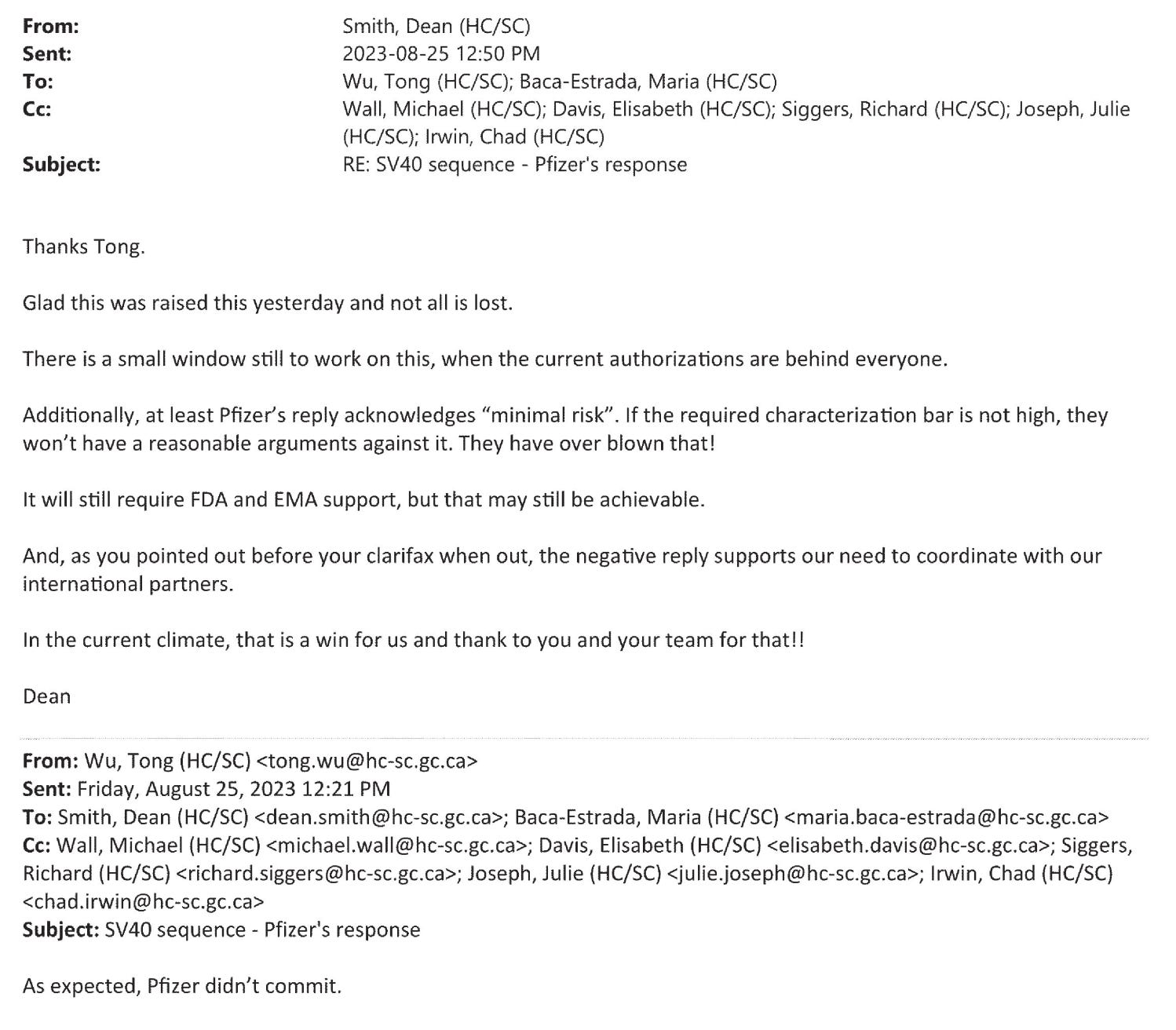
Health Canada told Pfizer to remove its SV40 promoter sequences from their covid vaccines in 2023. Pfizer refused. Health Canada has continued to approve the DNA-contaminated injections since then anyway. “Health Canada strongly recommends the removal of unnecessary DNA elements from the backbone of plasmids” … “However, the Sponsor only agrees to further evaluate Health Canada’s request”.
Heath Canada’s reviewers rejected Pfizer’s justification for keeping the DNA in the shots. “The review team disagrees with this justification”.
Pfizer never disclosed the presence of the DNA sequences (this was discovered by independent researchers McKernan et al. and brought to Health Canada’s attention by questioning from Chartier and Horwood at Epoch Times). “should have been disclosed initially”.
Parliament was told Pfizer had answered everything. Yasir Naqvi — Liberal MP for Ottawa Centre, as Parliamentary Secretary to the Minister of Health (then Mark Holland), told Dean Allison — Conservative MP for Niagara West: “Pfizer provided a reply to address all of Health Canada’s questions.” (Q-2670). False, Pfizer refused Health Canada’s strong recommendation to remove the DNA.
The investigation was dropped by someone above the expert staff regulators at Health Canada. The Issue Analysis Summary (IAS) was “deemed to be unnecessary as the residual DNA content… was consistently below… 10 ng/human dose.” This was likely Pfizer’s justification for not cleaning up their product that was rejected by Health Canada: “The review team disagrees with this justification.” The IAS can be found here.

References
50. Šenigl F, Soikkeli AI, Prost S, et al. The SV40 virus enhancer functions as a somatic hypermutation-targeting element with potential tumorigenic activity. Tumour Virus Res. 2024;18:200293.doi:10.1016/j.tvr.2024.200293
51. Dean DA, Strong DD, Zimmer WE. Nuclear entry of nonviral vectors. Gene Ther. 2005;12:881- 890.doi:10.1038/sj.gt.3302534
52. Strayer D, Branco F, Zern MA, et al. Durability of transgene expression and vector integration: recombinant SV40-derived gene therapy vectors. Mol Ther. 2002;6:227-237.doi:10.1006/mthe.2002.0657
