Licencia Creative Commons

Showing posts with label UBS. Show all posts

Tuesday, October 14, 2025

Unlawful write-off of AT1 capital instruments (14-10-2025); (Swiss Defend $17BN AT1 Bond Wipeout In Credit Suisse Deal (23-03-2023))

Swiss Defend $17BN AT1 Bond Wipeout In Credit Suisse Deal: by Tyler Durden Thursday, Mar 23, 2023 - 02:03 PM Amid the justifiably shocked outcry from Credit Suisse junior debtors, who saw their e...

 Press release regarding judgment B-2334/2023

 The write-off of the Credit Suisse AT1 capital instruments as ordered by FINMA in March 2023 lacked legal basis. The Federal Administrative Court has therefore revoked FINMA’s decree in a partial decision.

 14.10.2025


On 19 March 2023, representatives of the Federal Department of Finance (FDF), Swiss Financial Market Supervisory Authority (FINMA), Swiss National Bank (SNB), and the involved banks announced a comprehensive set of measures for the takeover of Credit Suisse (CS) by UBS. It included the write-off of CS’s entire Additional Tier 1 capital instruments (AT1 bonds) with a nominal value of approximately CHF 16.5 billion. On the same day, the Federal Council amended the recently adopted Emergency Ordinance with a provision (Article 5a) authorising FINMA to order a concerned bank to write off its core capital. Acting inter alia on this provision, in its decree also of 19 March 2023, FINMA instructed CS to immediately write off all AT1 bonds and to notify the respective bondholders, which CS consequently did.

FINMA decree of 19 March 2023 revoked
About 3’000 complainants lodged appeals with the Federal Administrative Court (FAC) against this decree in approximately 360 cases. In the resulting multiparty proceeding, these complainants participate in one and the same proceeding (one decree, same facts). A particularity of a such proceeding is that any party’s individual right to be heard extends to the submissions and evidence of all other parties, insofar as their requests may not be granted.

In essence, the complainants requested that the decree be revoked, and moreover, that the write-off be reversed. They contended that there was neither a contractual nor a sufficient statutory basis for writing off the AT1 bonds. For their part, FINMA and UBS primarily challenged the complainants’ right to appeal, and argued that, on 19 March 2023, the contractual conditions for writing off the AT1 bonds were met as well as that Article 26 of the Banking Act (BankA), Article 31 of the Financial Market Supervision Act (FINMASA) and Article 5a of the Emergency Ordinance provided sufficient legal basis for FINMA’s decree.

On 1 October 2025, the FAC passed a partial decision in one of the appeal cases. It confirmed the complainants’ right to appeal and revoked the decree of 19 March 2023. The FAC has not yet decided on the reversal request. The other cases are now suspended until the decision regarding the revocation of the decree has become final.

Prerequisites for write-off not fulfilled 

 
For regulatory purposes, AT1 capital instruments form part of a bank's additional core equity; they are typically structured either as conditional mandatory convertible bonds or, as at hand, as bonds with a conditional debt waiver (“write-off bonds”). Write-off bonds may be written off by the issuing bank upon occurrence of a contractually predefined event (“viability event”). The FAC held that the conditions for a write-off were not fulfilled because the contractual viability event had not been triggered: at the time of the write-off, CS was sufficiently capitalised and met regulatory capital requirements. The measures granted by the federal government and the SNB served solely to ensure liquidity and, according to a trust-theory based understanding of the bond prospectus, had no direct impact on the equity base.

Lack of legal basis
The Court further examined if there was a statutory basis for the write-off order. It considered that the bondholders’ property rights were seriously interfered with, which would have required a clear and formal legal basis. But no such basis existed: Article 26 BankA, which provides for protective measures in the event of an impending insolvency, addresses a different subject matter, and in any event, it is too vague to be relied upon for a write-off of third-party rights under the principle of legality. The same applies to Article 31 FINMASA and Article 5a of the Emergency Ordinance of the Federal Council. Since the decree of 19 March 2023 is based on the Emergency Ordinance, the FAC also examined its constitutionality on a preliminary basis. Article 5a of the Emergency Ordinance proved unconstitutional in several respects, namely because it violates constitutional requirements in relation to emergency ordinances by the Federal Council (Articles 184(3) and 185(3) of the Federal Constitution, FC), to the delegation of expropriation rights (Article 178(3) FC), as well as to the guarantee of ownership (Article 26 FC).

This decision is subject to appeal to the Federal Supreme Court.

 Partial decision B-2334/2023


Wednesday, May 8, 2024

LA REVISIÓN DE LOS RESULTADOS DE UBS, Q1-24 RESULTS REVIEW - JustDario

UBS Q1-24 RESULTS REVIEW - THE “LA LA LAND” BANK - JustDario: “UBS swings back to profit and smashes earnings expectations for the first quarter”, was the CNBC headline shortly after #UBS Q1-24 results announcement. But what about all other MSM? Everyone, of course, is jumping on the same celebratory bandwagon. I wonder how many of these people influencing markets and sentiment...

  #UBS is recognizing the gross revenues from #CS business EXCLUDING any negative effect from marking to market the assets acquired to their market value.

As if this wasn’t enough of a joke by itself, as a cherry on top of the cake #UBS is also excluding losses from their investment in SIX Group (the Swiss Stocks Exchange)


#UBS greatly understated Risk Weighted Assets (RWA) So #UBS holds a total of 1,607bn$ in assets and reports 546m$ of RWA, what’s wrong with that? Only 301bn$ of #UBS loans (605bn$) are guaranteed by any form of collateral.

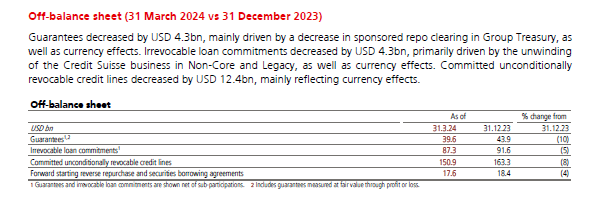
Ah, one more thing, #UBS also has 295bn$ of OFF-BALANCE SHEET assets

If we include this amount in our RWA calculation the result is ~46.5% assessment on their completely unsecured risk positions. Yes, that’s quite a lot of stretching.

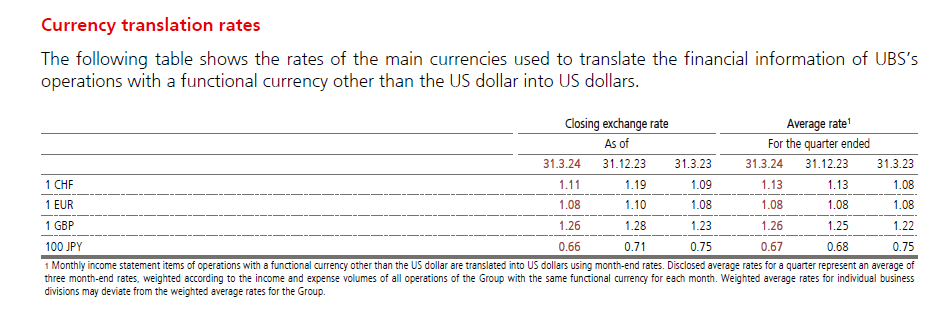
  – After we saw #HSBC doing that last week in “IS HSBC CEO “UNEXPECTEDLY” LEAVING BECAUSE THE BANK WON’T BE ABLE TO HIDE ITS PROBLEMS FOR MUCH LONGER?”, completely defying the laws of financial markets gravity even #UBS did not include any FX impact whatsoever in their Q1-24 results. No further comments are needed here.

 – What about Expected Credit Losses (ECL)? As you can see, #UBS is very optimistic about the future of the US and Swiss economies to the point that not only they IMPROVED their baseline expectations (picture 1), but they also completely removed a “Global Crisis” scenario from the projections in Q1-24 (picture 2). All this resulted in a meager 106m$ put aside for ECL and no, I am not joking.

 – Why is the Swiss Central Bank suddenly asking #UBS to increase their capital by ~25bn$ as per the “Swiss central bank calls for more capital rules after Credit Suisse saga” quickly forgotten “breaking news” from 2 weeks ago?

Reason 1: #UBS has a chronic hole in their brokerage business

...

 Reason 2: #CS’s “Negative Goodwill” of 27.7bn$ that was booked 2 quarters ago after applying its own “mark to market” to #CS assets marking a “historical” profit for a bank might not have been that positive after all (negative goodwill increases the revenues and assets in financial statements). What happens if those assets are worth 27.7bn$ less and #UBS’s CET1 capital instead of 78.7bn$ is 51bn$? Well… that will shrink their CET1 capital to 9.3%. What is the absolute minimum capital requirement for a G-SIB bank like #UBS (without considering increments because of the size)? 10%. There you go.

So basically #UBS is already under-capitalized because of #CS real asset values, still assuming their “La La Land” mark to markets on the rest of their books and the Swiss Regulator clearly knows it. Furthermore, this even excludes the “hole” we discovered in the #UBS brokerage business. I bet the regulator is aware of it too, hence the sudden “urgency” that is scaring off the bank’s management. What if we combine the 2? Well… #UBS’s CET1 will fall below the 8% absolute minimum requirement in the blink of an eye.

As I write, #UBS shares are trading up 8% celebrating the great Q1-24 results, I wonder if you agree with that now that you have read this article.

...

 Trust me, no one would be selling you something if they thought they would be getting a good deal out of it first. This is why I find it very hilarious to see investors buying shares of companies where their management consistently exercises their stock options and then liquidates the stocks shortly after in the market. I find it even more hilarious to see investors buying stocks of companies that consistently perform share buybacks in the market when prices are expensive, not the opposite. Isn’t this counterintuitive? With all the insider information they have, the management should be buying back stocks of their own company when these are cheap, not the opposite, right? Well… but when the stock is at the top, it’s the best time to cash out their bonuses paid in shares…

Feel free to disagree with me, but we’ve come to a point where investors are acting in the market against their own interests without realizing how their actions are counterintuitive in their nature. We’ve even seen extremes equivalent to investors buying a used car that was being set on fire in the parking lot. Why? Because they knew there is a buyer lining up right behind them that is willing to buy that too so if they bid first they could then resell it at a higher price, making a profit in the process.

How could all of this be sustainable and end well?


Thursday, April 11, 2024

NOW THAT THE JAPAN MAGIC MONEY TREE IS DEAD, EXPECT BANKS TO JUMP AT EACH OTHER'S THROATS - JustDario


NOW THAT THE JAPAN MAGIC MONEY TREE IS DEAD, EXPECT BANKS TO JUMP AT EACH OTHER'S THROATS - JustDario: The answer to any problem Japan faced in the past 3 decades was “let’s just print our way out of it” and every time the global financial system was more than happy to swallow every drop of freshly printed #JPY. What were banks doing with all that money that “magically”...

The answer to any problem Japan faced in the past 3 decades was “let’s just print our way out of it” and every time the global financial system was more than happy to swallow every drop of freshly printed #JPY.

What were banks doing with all that money that “magically” fell into their pockets and carried no interest to pay for its use? They were using it to accumulate “low-risk assets”. This particular category of assets is considered so safe by the regulators that a bank is only required to hold very little capital against it. This created 2 worlds: the real one with real risks and the “regulatory” one where, as long as you ticked all the boxes, the regulator gave you so much leash you could practically do whatever you wished without fear of being bothered.

 The open secret in the street is for governments to use PSE and MDB entities to issue debt in lieu of the country so the administration in charge has the resources to finance its spending budget without officially piling up sovereign debt. Why did banks start to lend hundreds of billions without any concern to these entities? Because no government will ever have the guts to not bail them out and make lenders, bankers call this “implicit guarantee”. Imagine what a great deal banks got, on one side you can earn a spread higher than government bonds, but on the other side, you virtually carry the same credit risk. Yes, this will cost you some capital, but if you have access to enough leverage at zero costs you can incredibly goose your ROEs carrying (virtually) no credit risk. This is exactly when the Bank of Japan’s reckless infinite QE policy of the past 3 decades became handy.

So banks started to pile up on JPY carry trades spreading liquidity across the world through PSE and MDB, except Japan (and the “experts” at the BOJ never understood this is why they kept seeing little to no effect of QE infinity on the Japanese economy).

What do you think banks did when they lent so much to PSE and MDB to the point that their needs were saturated? As they always do, they started to go down the credit spectrum risk. In particular in one specific area: “covered bonds”.

What’s special about “Covered Bonds”? Well… let me show you the criteria a bond “covered pool” (the collateral) has to meet to fall into the category:

(1) claims on, or guaranteed by, sovereigns, their central banks, public sector entities or multilateral development banks;

(2) claims secured by residential real estate that meet the criteria set out in CRE20.71 and with a loan-to-value ratio of 80% or lower;

(3) claims secured by commercial real estate that meets the criteria set out in CRE20.71 and with a loan-to-value ratio of 60% or lower; or

(4) claims on, or guaranteed by banks that qualify for a 30% or lower risk weight. However, such assets cannot exceed 15% of covered bond issuances.

Isn’t it pretty obvious the massive “regulatory arbitrage” here? Yes, it is.

So basically banks needed 2 things: a constant supply of assets and low RWA requirements by the regulator. Banks found both in point (2) and (3) above. Do you know how many covered bonds guaranteed by Residential Real Estate or Commercial Real Estate received a rating below AA- (hence not so attractive for banks) when issued? Virtually zero. Yes yes I know, 2008 all over again.

I can continue very long to show how banks focused on finding loopholes in the Basel regulation to maximize their returns posting as little capital as possible, but I believe now you got my point.

So basically the Bank of Japan was an endless source of leverage for the global financial system and banks exploited it above and beyond any prudent limit. On paper, they all looked great for the regulator, then tell me how is it possible that one year ago Credit Suisse (a global systemic bank) needed a public bailout to avoid a dangerous Lehman-style implosion?

Now that the #JPY carry trade is creating larger and larger holes in bank books ($JPY CARRY TRADE – THE BIGGEST FINANCIAL TICKING TIME BOMB OF ALL?), the next thing you are going to see is banks going after each other to claim the collateral they are owed to contain the damage and not being forced to start unwinding positions in the open market at a steep loss. Well… good luck with that!

In the era of wild asset rehypothecation, mounting volumes of “fail to deliver trades” in clearing houses across the world, shadow banks with no capital starving for liquidity (never forget banks were very happy to lend to Private Equities and Asset Managers as long as they pledged Residential or Commercial real estate assets as collateral) and derivative books of gargantuan sizes (MR. MARKET HAS BEEN FULLY REPLACED BY MR. DERIVATIVES – OH MAMMA MIA!), no bank can guarantee the numbers in their books are sound (exactly like in the case of Credit Suisse).