Licencia Creative Commons

Showing posts with label JUSTDARIO. Show all posts

Thursday, June 11, 2026

EL TRISTE FINAL DE TODO EL SUEÑO DE LA INTELIGENCIA ARTIFICIAL (11-06-2026; JustDario)

THE UNHAPPY ENDING OF THE WHOLE AI DREAM


While I was waiting for Oracle numbers, a very interesting headline came out: “China plans $295bn state-directed AI buildout as Beijing moves to lock out Nvidia and AMD”.


This is what I wrote about 8 months ago in “THE DATA CENTERS FRENZY WILL BE REMEMBERED AS THE LARGEST WASTE OF CAPITAL IN HISTORY”:

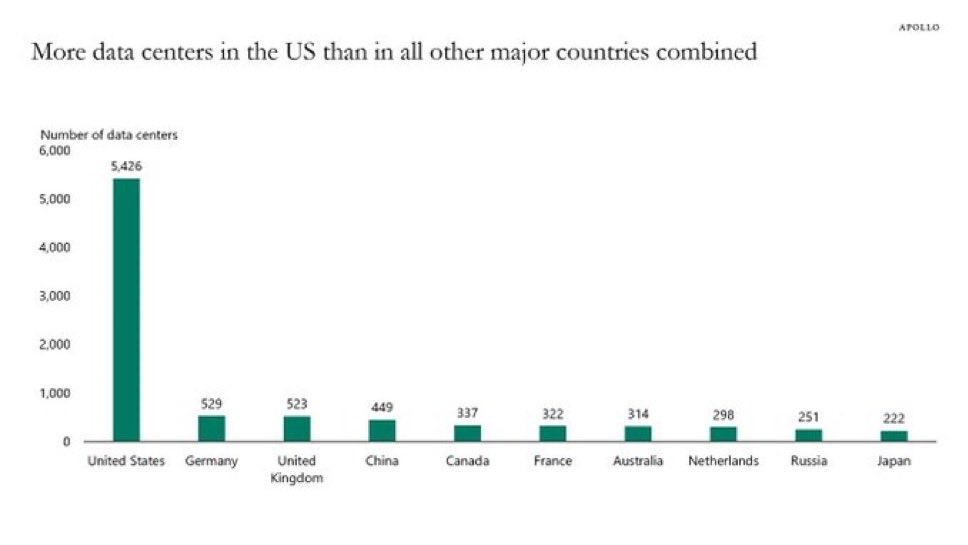
“As you can see in this chart, the number of data centers operational in the US right now is greater than all other countries combined and ten times higher than Germany, the second country by number of data centers.”

“Yet, nobody sees anything wrong with this. Let me ask a question: if there is a global AI arms race ongoing, then why aren’t all other countries participating?”

China, a country of 1.4 billion people and the second largest economy in the world, just committed to spending on building data centers over the next 5 years, roughly the same amount Google alone is expected to spend in one year. Furthermore, the strict condition to build data centers will be using 80% or more of domestically produced semiconductors. Is China doing this to protect Huawei and its other domestic companies, or is there something very wrong with how the whole AI data center buildout in the US around Nvidia, AMD GPUs at first, and now other alternatives like Google TPUs is developing? Of course, there is something very wrong with what has been happening in the US for many years now, and it never took a genius to figure that out; all that was needed was paying attention because the numbers never made any freaking sense.

Now that investors are starting to ask one simple question, “Why are you still not making much money after we gave you hundreds of billions of capital?”, you can notice all they can answer is “Trust me, bro.” This behavior is, unfortunately, not what lenders like to hear. Not surprisingly, you can observe how more and more companies are being refused new requests to borrow money and are instead forced to raise cash by issuing equity. Those that will still be able to entice lenders and not dilute their capital will only be companies with a sustainable business that can sustain an increasing debt burden.


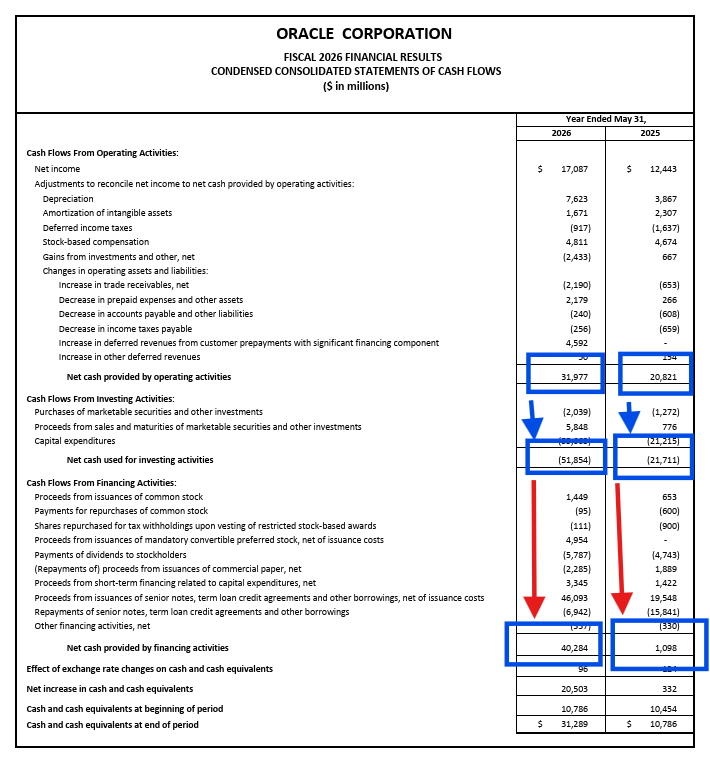
Oracle is the most glaring example among all; just compare the cash flow numbers between FY 2025 and the FY 2026 just reported

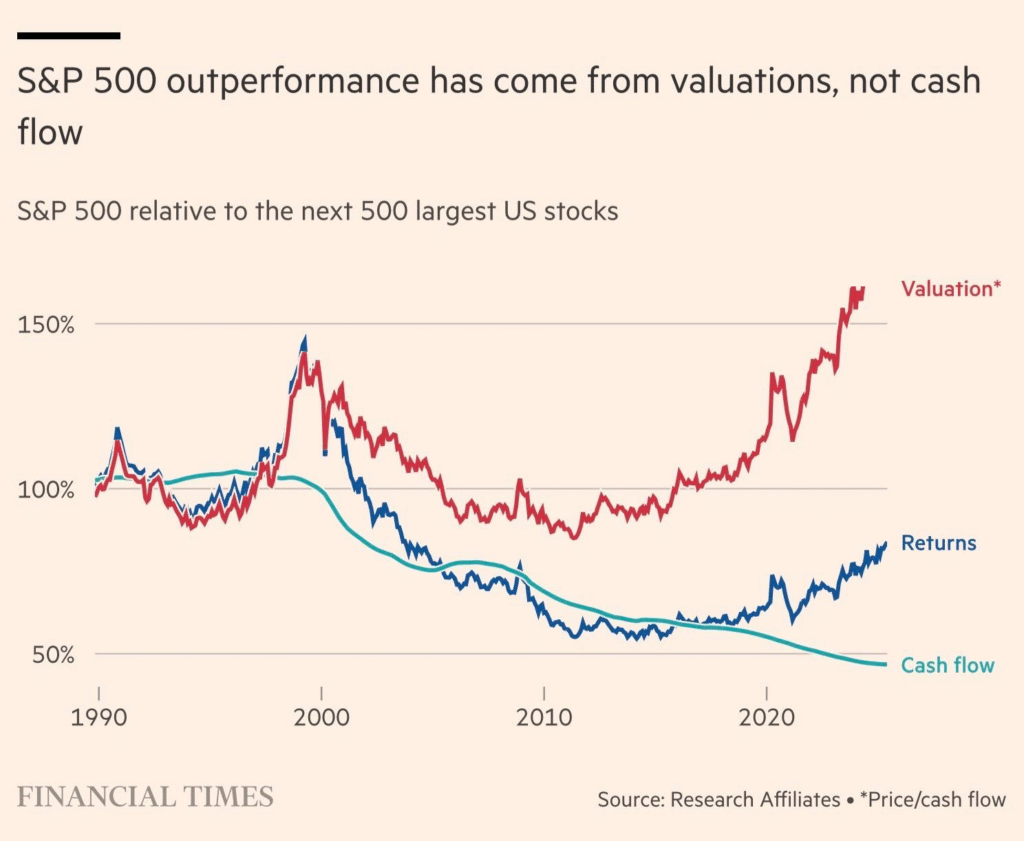
In one column, you can see a software company venturing carefully into a new business. In the other column, you can see an infrastructure company with a software business attached to it. With the exception of Apple, you can observe the exact same trend among all the major tech mega-cap companies.


This great chart from the FT perfectly summarizes what I just described:

The end of the story is already written: investors are tapping out, lenders are tapping out, and there isn’t enough cash in the markets to support everyone anymore. Google, Amazon, Microsoft, and Meta will be able to raise a little more because there is still a buffer in their legacy operations, not their AI business- but they will hit the brick wall too eventually. This time, though, don’t expect their valuations to quickly recover in the next cycle of FED quantitative easing that will be required to bail out the whole financial system, blaming the oil crisis because all these companies will be burdened by so much debt, write-downs, and legacy costs that any cash flow will be diverted to service their debt and remain in business, not to reward investors this time.

Wednesday, July 2, 2025

LOS TESTS DE STRESS DE LA FED Y LOS PROBLEMAS DE LOS BANCOS SUPERVISADOS


2025 FED STRESS TEST REVEALS HOW TODAY’S FED IS COMPLICIT IN HIDING BANKS’ PROBLEMS

The Federal Reserve just released the results of its 2025 round of stress testing on 22 major US banks, and personally, I have never come across something more ridiculous and hypocritical. Let’s start with the fact that the FED itself admits how it found it appropriate to make this year’s test easier: “The only material changes to the models in the 2025 stress test are those that the Board began to phase in during the 2024 cycle, and the change in the treatment of private equity that was described in the December 30, 2024”
 
 Hold on a second, isn’t lending to Private Equity the largest balance sheet item by far, even beyond real estate lending, of many of the 22 banks surveyed? Yes, it is. According to the report “Growth of Bank Lending to Private Equity and Credit Funds” published by the Boston FED back in February this year, as per data shared by the banks during 2024 stress tests, total loan commitments to “Non-Bank Financial Intermediaries” (i.e., Private Equity firms) stood at 2.2 trillion USD or 32% of total loan commitments.
 
So, what did the FED do in the 2025 stress tests? Yes, it acknowledged the significant risk attached to banks’ lending toward NBFIs, saying:

“The NBFI stress is motivated by rapid growth in large bank credit commitments to NBFIs over the past five years, which reached about $2.3 trillion in the fourth quarter of 2024 at large banks. While total loans at large banks increased by 21 percent over this period, lending to NBFIs at large banks has grown by 56 percent. This rapid growth poses risks to banks, as certain NBFIs operate with high leverage and are dependent on funding from the banking sector.”

 “As part of the 2025 stress test, private equity exposures are removed from the global market shock component of the stress test. Instead, losses on these exposures are projected under the severely adverse macroeconomic scenario. This change better aligns with the characteristics of private equity exposures, which are principally long-term investments that are managed as banking book positions”

Let me just show you a sample of the most recent headlines about the state of the Private Equity sector:

Here is the result of the FED stress test on NBFI exposure in its own words: “Under NBFI stress, the aggregate CET1 capital ratio is projected to fall by 1.6 percentage points to a minimum of 11.8 percent. Through the nine-quarter projection, total loan losses are estimated around $490 billion.” Please accept my apologies, but I truly struggle to come up with the math the FED used to translate 490 billion USD of potential losses into just a 1.6% decrease in the aggregate CET1 capital. Perhaps they used theorems and futuristic mathematical rules not yet available to common people like us. 
 
The most ridiculous part of all of this? The 490 billion USD of total projected losses from NBFI alone aren’t included in the total projected losses under the stress test, as I highlighted before and as you can see in the summary here.
 

Here is the result of the FED stress test on Hedge Fund and Trading Losses in case of a “market shock” scenario:

“The results of the exploratory market shock element suggest that the largest and most complex banks can withstand a market shock stemming from higher inflation expectations. Under the exploratory market shock scenario, trading losses at U.S. global systemically important banks (G-SIBs) are expected to be about $17 billion. Aggregate losses from the assumed default of the hedge funds are moderate, amounting to roughly $8 billion.”

If we consider the whole sample of 22 financial institutions part of the stress test, in the most adverse scenario, the FED projects a total of 44 billion USD losses related to trading and prime brokerage activity. I believe there is no need to describe these idiotic results further.

According to the FED stress test, Bank of America is expected to lose 23 billion USD under the most adverse scenario. What’s wrong with this? Well, this bank right now already has roughly 100 billion USD of “paper losses” in its books. More details in my latest article on this lender: “BANK OF AMERICA’S Q1-25 EARNINGS: MORE SMOKE AND MIRRORS TO HIDE ITS INSOLVENCY“.

I believe this is enough to prove without a shadow of a doubt how today’s FED is complicit in hiding banks’ problems rather than doing its job to fix them beforehand and avoid a financial catastrophe that at this point is just a matter of when it’s going to happen, not if it’s going to happen.


JustDario on X | JustDario on Instagram | JustDario on YouTube


Wednesday, June 4, 2025

SECTION 899 OF "THE BIG BEAUTIFUL BILL" (LA GUERRA TRIBUTARIA)


SECTION 899: THE NUCLEAR TARIFF


Subsection (a) – Increased Rates of Tax on Foreign Persons of Discriminatory Foreign Countries

This section imposes higher tax rates on individuals and entities from countries that enforce unfair taxes against U.S. persons. The increased rates apply to various taxes, including those on nonresident aliens, foreign corporations, and real property gains. The hike starts at 5 percentage points, rising by 5% annually (capped at 20% above the original rate). Special rules modify the Base Erosion and Anti-Abuse Tax (BEAT), raising its rate from 10.1% to 12.5% and tightening deductions. Withholding taxes on payments to foreign persons are also increased, except for the 14% FIRPTA rate. Temporary safe harbors protect withholding agents from penalties before 2027 if they make good-faith compliance efforts.

Subsection (b) – Definition of “Applicable Person”

An “applicable person” includes foreign governments, non-U.S. individuals, and corporations tax-resident in discriminatory countries. It also covers foreign corporations more than 50% owned by such persons, private foundations, trusts, partnerships, and other entities benefiting primarily from discriminatory tax regimes. If a person temporarily stops qualifying as an “applicable person” for less than a year, they remain subject to the increased taxes during that period.

Subsection (c) – Definition of “Unfair Foreign Tax”

An “unfair foreign tax” includes digital services taxes, diverted profits taxes, and extraterritorial taxes that disproportionately burden U.S. persons. Discriminatory taxes are those that target nonresidents, apply to income outside the taxing country, or lack deductions for costs. Exceptions apply to standard income taxes, VAT, sales taxes, property taxes, and taxes covered by double-taxation treaties. The Treasury Secretary can identify additional unfair taxes or grant exceptions.


Subsection (d) – Other Definitions

A “discriminatory foreign country” is any nation enforcing unfair taxes. The term “foreign country” includes political subdivisions and dependent territories (excluding U.S. possessions). The definition of “tax” encompasses not just rate increases but also base expansions, denial of deductions, or other adjustments that effectively raise liability.

Subsection (e) – Regulatory Authority

The Treasury Secretary must issue regulations to enforce these rules, including measures to prevent tax avoidance. The Secretary can provide exceptions, adjust rules for partnerships and branches, and ensure the BEAT modifications do not result in double taxation.


As of end-2024 data, it is estimated foreign investors hold abroad ~14 trillion USD worth of U.S. stocks, ~12 trillion USD of U.S. government bonds, and ~4 trillion USD of U.S. corporate debt. As of today, there is virtually zero U.S. withholding tax on gains on this enormous amount of assets. This was one of the key factors that favored the USD adoption as a global reserve currency, effectively the only one left today, but it is also one of the most exploited loopholes in the world to maximize profits while minimizing taxes due to the U.S., especially by U.S. domestic corporations. How? Very simple: thanks to sophisticated transfer pricing mechanisms, most of the profits are held outside of the U.S., and the cash piled up in favorable taxation countries like Ireland or Luxembourg is then reinvested into USD-denominated assets that remain held abroad. This is the reason why you see companies like Apple or Microsoft issuing onshore debt in the U.S. to pay dividends or buy back stocks despite the large amount of cash piled in their balance sheets. This loophole is also used by U.S.-based institutional investors like hedge funds that set up some of their operations abroad in jurisdictions like the Cayman Islands.

 Section 899 is clearly not only a warning to foreign countries (more on this soon) but also a warning to corporations that have been exploiting the U.S. taxation regime greatly for many years, effectively depriving the country of a large amount of tax revenue that the U.S. is now more and more in need of. Exploiting this loophole was of great benefit to U.S. financial markets and those companies with ample access to it, but it also deprived the real economy of resources and capital investments, facilitating the accumulation of wealth among those who hold financial assets (a limited portion of the population). This, combined with QE, pushed things to an extreme level of wealth inequality everyone today is familiar with.

The threat to countries here is pretty straightforward, isn’t it? The U.S. government is laying the ground for labeling a large number of other countries’ policies as “unfair” and “discriminatory” and targeting them with a specific tariff that can wreak havoc on their domestic financial systems as a consequence. For example, what do you expect is going to happen if the U.S. tomorrow labels Ireland’s tax regime, notoriously very convenient for many corporations operating in the U.S., as unfair and discriminatory? Investors holding a huge amount of USD assets in those jurisdictions won’t take long to pick up the phone and call their lawyers and bankers to shift all those assets elsewhere, delivering a huge blow to Ireland first and to the European Union afterward because investors will surely assume similar measures will be extended to the union as a whole in order to close the favorable loophole exploited from the region for many years. If you think such a shift of capital from one region to another will be inconsequential, it is instead the complete opposite. Why do you think the European stock market, for example, is enjoying such a large amount of demand from foreign investors, disconnecting valuations from the real economy so much? The presence of that amount of assets in the region also translates into the presence of a large amount of collateral that financial intermediaries can access to fetch liquidity and reinvest it in Europe.

The more USD debt matures, the higher the amount that is expected to be reinvested in foreign assets, especially by private investors, and this will gradually raise yields until these become attractive again for foreign holders who will now have to pay a tax on gains. Needless to say, this will significantly increase U.S. government debt costs in the long term, which will require a bigger amount of money printing to remain sustainable because I can guarantee you the new inflow of taxes will not compensate for the loss, as is usually the case. This is why Section 899 isn’t meant to be a global blanket tax but can be used effectively to target specific countries, favoring other U.S. allies that are more open to coming to terms with the U.S. administration on the commercial trade front and corporates that will be willing to deploy capital back into the U.S. 

By now there should be no more doubt about the “nuclear tariff” definition I gave to Section 899, a tariff that will be more of a threat than a real weapon the U.S. is willing to use because in the long term, it can create a dangerous precedent and push more countries to shift away from the USD as a reserve currency, effectively creating two “blocks” in the global economy. On one side, countries that will see limited to no damage from U.S. decoupling will move further away, while on the other side, countries that cannot live without U.S. consumer demand will be forced to bend the knee and become even more dependent on the U.S. Considering the growing amount of U.S. debt, a decoupling will surely decrease the long-term demand for U.S. government bonds with dangerous consequences for the global financial system, but if the U.S. administration ultimately comes to a point where they think it will be a risk worth taking because more taxes and re-industrialization of the U.S. economy will be of greater benefit and help repay the debt in the long term, then no one should be shocked if at a certain stage this nuclear tariff will be used in the same way the nuclear bombs were used on Hiroshima and Nagasaki to send a strong message to the whole world.


"Fire! for God's sake fire!" — and thousands shared the fate of Davis and Hosmer.There was not one hireling there.I have no doubt that it was a principle they fought for, as much as our ancestors, and not to avoid a three-penny tax on their tea; and the results of this battle will be as important and memorable to those whom it concerns as those of the battle of Bunker Hill, at least.”

(HDT, Walden Brute Neighbors)

The One Big Beautiful Bill Act: An Initial Analysis of Key Tax Proposals

Skadden Publication

On May 22, 2025, the House of Representatives passed the One Big Beautiful Bill Act (OBBBA). Tax-related proposals contained in the OBBBA would extend or make permanent select corporate, international and individual tax provisions originally enacted as part of the Tax Cuts and Jobs Act of 2017 (TCJA) that either have expired or are scheduled to sunset on December 31, 2025.


The OBBBA also contains several other provisions, including:


- Retaliatory measures against foreign countries that have enacted certain “unfair foreign taxes.”


- An increase of the cap on state and local tax (SALT) deductions of individual taxpayers to $40,000 and new restrictions on SALT deductions for certain partnerships.


- Significant modifications to green energy tax credits enacted under the Inflation Reduction Act (IRA).
 

The Senate is expected to take up the OBBBA in June 2025, with a target date of July 4, 2025, set for the bill’s enactment. Below, we summarize key aspects of the OBBBA and provide our preliminary analysis

Wednesday, February 19, 2025

LA IMPLOSIÓN DEL BANCO JAPONÉS NORINCHUKIN


NORINCHUKIN BANK IMPLOSION OFFICIALLY BEGINS

During the last quarter alone, Norinchukin Bank incurred a ~500bn JPY net income loss, bringing the total for the first quarters of this fiscal year to ~1.4trillion JPY, equivalent to ~9.2bn USD. Where do these losses come from? They come entirely from Norinchukin Bank’s securities portfolio, which shrank from ~38 trillion JPY to ~35.6 trillion JPY at the end of December 2024. From another perspective, this means that Norinchukin lost ~20% on a 2.4 trillion JPY face value of assets liquidated.

If we already apply the ~20% discount on the real price that the bank could fetch in the market to the ~35.6 trillion JPY of Securities left in its portfolio, the unrealized losses instead are ~7.12 trillion JPY. Considering that the bank only has ~4 trillion JPY of Net Assets left, it is becoming harder and harder for the Bank of Japan and the Japanese government to hide the fact that the second largest bank in the country is more and more insolvent and in desperate need of a bailout to stay in business.

 One thing that struck me the most in the latest Norinchukin Bank financial report is the table “Summary of Performance” which you can see below. Please take a look at the metrics for the third quarter of 2024. Do you notice anything incredible? Yes, my dear reader: EVERY SINGLE PERFORMANCE LINE IS NEGATIVE.

So why did Norinchukin sell all those securities in the last quarter and crystallize such a large amount of losses previously hidden in the hold-to-maturity books? Because the bank’s liquidity crisis is worsening:

  • Deposits fell in one quarter from ~58.9 trillion JPY to 57.9 trillion JPY
  • Repurchase Agreements (in Liabilities, hence money borrowed against collateral) fell in one quarter from ~9.3 trillion JPY to ~6.2 trillion JPY

Total = minus 4.1 trillion JPY

The bank has been trying to raise capital since May last year (Japan’s Norinchukin Bank eyes raising $7.7bn in fresh capital), but as I flagged already at that time, whoever could read and properly analyze the books of the bank knew they were already insolvent and hiding a massive hole. Considering how much liquidity is being printed non-stop by central banks these days and how bullish stock markets are, if Norinchukin cannot raise capital in the best possible market conditions, then its fate is sealed and in the near future it is doomed to implode unless the government steps in with a massively expensive bailout. Failure to bail out this bank will have incredible repercussions in the global financial system, similar to those that would have occurred if Credit Suisse was let to collapse. The problem here is that governments will not be able to afford to bail out all these giant banks forever, and the scary thing is so many are in this very same situation and I won’t stop warning about it.

Saturday, November 23, 2024

BUCEO PROFUNDO MÁS ALLÁ DE LOS NÚMEROS (APAÑADOS) DE NVIDIA (JustDario, 22-11-2023)


 Currently, Nvidia is the company with the highest market capitalization in the world

 When I started bringing the spotlight on Nvidia more than one year ago (full archive), only myself and a bunch of “Twitter Randos” (as they called us at that time: Wall Street analyst defends Nvidia from ‘Twitter randos’ spreading bearish conspiracy theory) dared to raise questions on Nvidia numbers and mind-blowing management projections for the future. One year later, the “Twitter Randos” are not alone anymore, and so many social media accounts have come forward raising more than legitimate questions about Nvidia’s business and numbers, highlighting all the incongruences and dark sides no one cared about so much before.

 What I am going to do in this article is step up the analysis of Nvidia financials one notch, but I promise I will do my best to keep it simple to understand. Please bear in mind several of the tables I am going to share are a comparison between the latest and the previous 10-Q where the red lines and text in red represent the amendments the company made in the new quarter.

 Why does Nvidia hide the geography of a growing amount of its revenues?

 This is how Nvidia describes its revenues attached to Singapore:

“Most shipments associated with Singapore revenue were to locations other than Singapore and shipments to Singapore were insignificant”

So according to the company, almost 8 billion USD of revenues in the last quarter, 22% of the total and the largest chunk outside the US market, were sent to an undisclosed location. One year ago, this amount was ~2.7 billion USD and ~15% of the total. Isn’t it a fair question to ask where these revenues are really being generated from? Furthermore, if there is nothing wrong with the end destination, what’s the point of hiding the end location and being more transparent with the investors’ community? It doesn’t take an accounting genius to figure out there is something wrong going on here.

“Strong demand” for Hopper but no increase in future purchase obligations for Hopper?

As you can read in the paragraph below Nvidia claims “Demand for the Hopper architecture is strong and our H200 offering grew significantly in the quarter” and that Hopper (not BlackWell) has been the driver of Nvidia’s spectacular growth so far.


 I wonder how it is possible that the company claims strong demand for Hopper but then its clients aren’t placing purchasing orders for it. Strange, isn’t it? As you can see from the table below, Nvidia even struck out the reference to “Hopper” in the purchase obligations section.


Does this have anything to do with the Mark To Market assumptions based on subjective management estimates to evaluate the value of Hopper inventories? Of course it does, but clearly, here we have a pretty big contradiction and I wonder if NVIDIA auditor PwC will close an eye on it.

Unusual Account Receivables concentration

It is very well known now that the majority of NVIDIA revenues come from a handful of customers, notoriously Microsoft, META, and SMCI, however, what I did not see anyone highlighting is a similar concentration in Account Receivables too.

53% of the account receivables are against four direct customers only (who knows about the “indirect” ones), and considering this amount keeps growing significantly (chart credit to @1CoastalJournal), it’s very hard to push back that feeling these customers aren’t paying the bills, but NVIDIA keeps delivering products to them, isn’t it?


NVIDIA invoices paid in advance and booked as revenues in the current quarter

While there are clients piling up bills with Nvidia, there are also clients that are so eager to pay them even before an invoice is issued to them. Crazy, isn’t it? Apparently not.


As you can see, it is something that happens every quarter. Hold on a second, by how much did Nvidia “beat” Wall Street revenues consensus this quarter? ~2bn$. How much is the amount of these advance payments booked as revenues in the current quarter? ~1.7bn$. Where is the rest of the “beat” coming from? From “Deferred Revenues” the company already disclosed LAST YEAR.

Dear reader, hopefully, you will agree with me that this revenue “beat” was totally fabricated (like the previous ones)

 From two “indirect” customers to one

As you can read below, in the previous quarter Nvidia had two “indirect” customers that represented more than 10% of the revenues each. This was a red flag I highlighted already at that time and very unusual for such large customers not to deal directly with the company and prefer to go through a “middleman,” isn’t it? This quarter only one “indirect” customer is left and it is fair to wonder whether SMCI troubles had anything to do with it considering part of the company business was notoriously to play the middle man.

Furthermore, how did NVIDIA fill the void left open by the fallout with this “indirect customer”? Perhaps they started to deal with it directly considering a brand new “Customer A” filled the spot for the exact amount.


 Are future lease costs kept off-balance sheet to boost the Net Income?

As you can easily observe in the table below, NVIDIA reported a net total of ~1.5 billion USD of future lease obligations, however as you can read in the highlighted part, they instead disclose their future lease obligations until 2030 are 4.2 billion USD. Somehow 2.7 billion USD of future lease liabilities disappeared from NVIDIA’s balance sheet and no one noticed. What happens when a lower number of liabilities is being reported? The equity portion increases to compensate. By how much did NVIDIA Net Income increase compared to the previous quarter? Coincidentally 2.7 billion USD, crazy isn’t it?


Are higher operating costs expected next quarter due to Nvidia waiting more than one year to apply the new accounting standards?

I believe the language below is quite self-explanatory, isn’t it? As you can read, Nvidia delayed the disclosure of significant expenses in its operating segments for more than one year since the new FASB rule was in place. Furthermore, this month a new FASB rule has been issued to increase company disclosures about additional expenses, in particular with regards to inventory purchases. No worries though, I do not expect NVIDIA to be so adamant about applying it right away starting from the next quarter that coincides with its annual report subject to audit.


A DEEP DIVE BEYOND NVIDIA (COOKED) NUMBERS

Monday, October 7, 2024

CRECIENTES SEÑALES DE PROBLEMAS DE LIQUIDEZ ENTRE LOS GRANDES BANCOS EN USA Y UK (JustDario, 6-10-2024)

 As a matter of fact, since the JPY Carry Trade forced unwinding started to bite, the BOE has been busy injecting liquidity into the system (THE JPY CARRY TRADE IMPLOSION CONTAGION IS ALREADY SPREADING INTO THE UK) with the BOE Short term repo OMO growing from zero to ~40m GBP in a few months till now. 


Please have a look at the chart below from 2022 to 2023 (when the latest banking crisis surfaced in all its beauty). As you can easily notice, while large banks’ deposits only decreased slightly overall (likely the reason why it took a while for the MSM and furus to realize a crisis was brewing), cash held at large US commercial banks part of the Federal Reserve system was collapsing in a clear sign of a liquidity crisis.


You can see the situation started to improve exactly at the moment the FED BTFP became operational, so no, the problems were not only within US regional banks contrary to what all the Central Bankers, Nobel prizes, and public officials were claiming. Credit Suisse’s emergency bailout was another proof of that, but still greatly ignored.

 Now, please have a look at what’s happening today despite Jerome Burns just declaring the FED cut rates by 50bp despite everything being awesome in the economy and in the financial system


What’s even more interesting is that Cash is being moved from Large to Small banks in equal proportions even if there has not been a similar shift in deposits. What does this mean? Clearly, customers still trust large banks, but clearly, smaller bank treasurers aren’t trusting them in the same way and are shifting cash back into their books.


At this point, I hope we all agree there are liquidity issues within Large US Banks with Bank of America the number one suspect at the moment. Why? Here is what I warned about two months ago and since then Warren Buffett sold $8bn USD worth of BAC shares and is just 0.1% away from going below the 10% ownership threshold after which he will not be required to inform the market promptly of any further sale (so likely he is going to cut his stake at a faster pace)

Putting all together, it is undeniable that there are increasing liquidity issues in both the US and the UK, but no worries next Friday when banks start reporting there will be little chance that they will confirm this to the public. Especially Bank of America which is expected to report its Q3-2024 on the 15th of October. Furthermore, we are one month away from US elections so do not expect the SEC or the FED to take any action to tackle this problem because the political embarrassment for the incumbent US administration seeking re-election will significantly undermine their effort to make everything look awesome in both the economy and the financial system. Personally, I do not expect a 2008-style “Lehman moment” before elections either, but there is always a small probability that things go out of control all of a sudden if fears quickly spread among financial institutions.


MOUNTING SIGNS OF LIQUIDITY PROBLEMS AMONG LARGE US AND UK BANKS

Tuesday, August 27, 2024

CÓMO PUDO RECUPERARSE JAPÓN DE SU PEOR "CRASH" DESDE 1987- SU GPIF "ANGEL"” - JustDario

HOW COULD JAPAN RECOVER SO FAST FROM THE WORST CRASH SINCE 1987? THANKS TO ITS GPIF “ANGEL” - JustDario: No person can pretend to know everything; it is simply not humanly possible. If anyone claims to do so, more often than not, they actually know little in reality. Personally, I use an investigative approach in everything I do, most of all to fill the gaps in my ignorance. This...

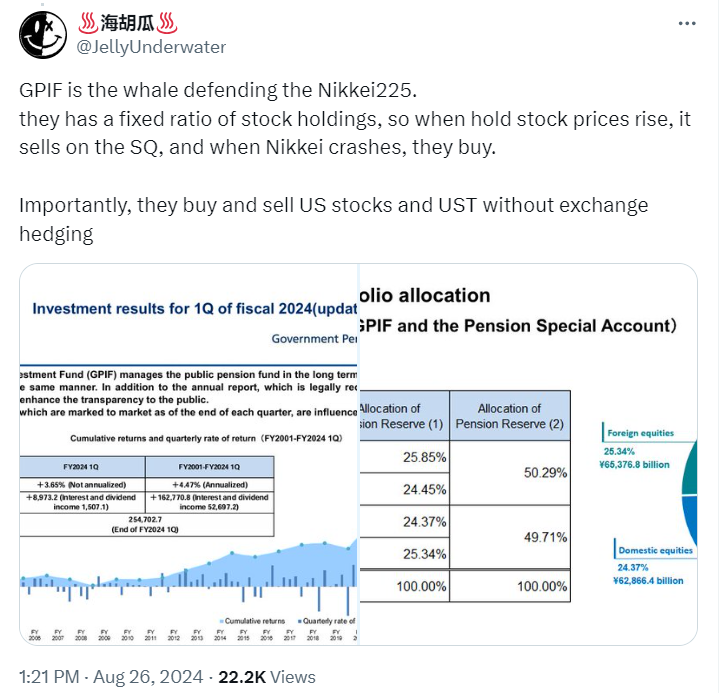
 Sometimes, like today, I receive one of those comments that might easily get lost in the ocean of social media, but that in reality deserves much bigger attention since there is great value in it. This is the comment I received to this post on X:


GPIF stands for “Government Pension Investment Fund” of Japan and is literally the largest pension fund in the world with 258 trillion JPY, about 1.8 trillion USD at the current FX rate, of AUM as of the end of June 2024. These are the investment principles upon which Japan’s public pensions are being managed: 
 
 Minimal risk and long-term perspective 
Diversification by asset class, region, and timeframe 
Maximize returns against benchmarks using a mix of active and passive investing 
Focus on ESG principles 
Pursuing initiatives to promote long-term growth of investee companies and the market as a whole 
 
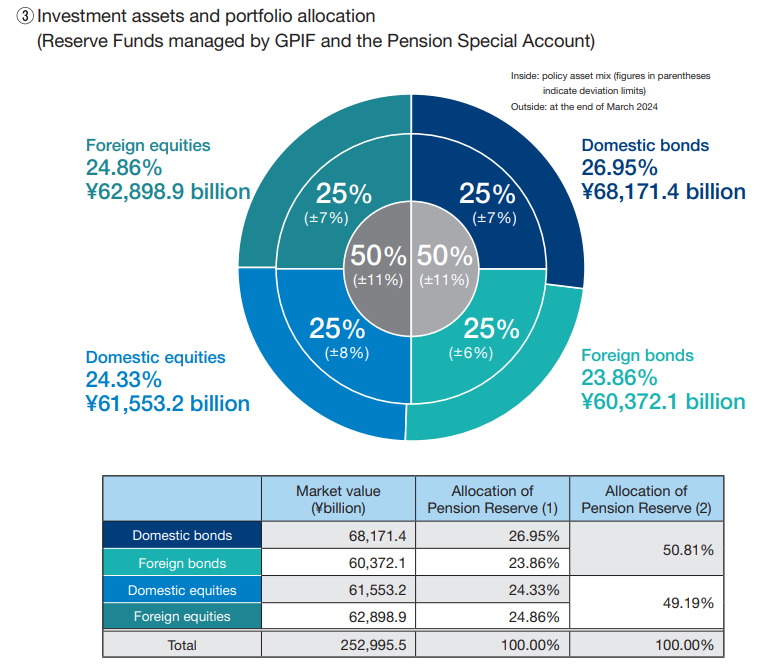
 All of these principles translate into a very simple, yet (so far) efficient portfolio management strategy you can see below:


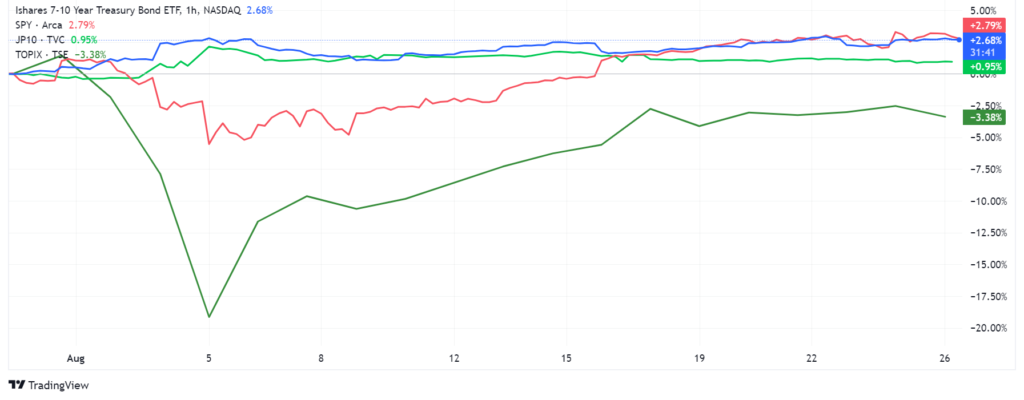
As you can see from the chart below, since BOJ and FOMC policy decisions of the 31st of July that triggered a brutal JPY carry trade unwinding, US Treasuries and JGB appreciated while the TOPIX and SPY, after crashing almost 19% and 6% respectively into the 5th of August, then started an epic recovery.


So what likely happened in those days? Considering GPIF investment principles and strict asset allocation policies, it is very fair to assume that the largest pension fund in the world was actively trading in the market and, with the help of BOJ, FED, and other Central Banks, effectively saved stocks, especially Japanese ones, from an epic collapse. How did they exactly do it? 
 
Considering Japan stocks were crashing on the 5th without a chance to find a bid, the first “help” came from the BOJ that started to buy JGB, pushing yields lower even if they just pretended to stop actively doing so a few days before. 
 
Thanks to BOJ’s actions, the GPIF started to sell JGBs to the BOJ and bid Japanese stocks aggressively, creating a bottom first and then igniting a relief rally into the close because it quickly had to rebalance its portfolio asset allocation. However, this clearly was not enough. 
 
When Europe and US stocks began to trade, the GPIF was such a big seller into the market that market makers’ liquidity quickly dried up to the point many brokers had to pull the plug to avoid a market going “no bid” and begin to free fall due to panic selling. 
 
In this context, the action of FED, ECB, and other central banks, added to the “flight to safety” into government bonds, creating a strong bid for GPIF to sell into, rebalancing this part of its portfolio without a big impact on the market like it happened to JGBs hours before. 
  • Algorithms clearly picked up this flow and started to front-run it, bidding hard on Japanese stock futures, hence helping to ease the “mark to market” losses in that portion of GPIF portfolio further and limiting their pressure to liquidate US and Europe stocks in the market.
  • With the liquidity raised from selling Foreign government bonds and stocks overnight, on the 6th of August, the GPIF could then burst into the Japanese stock market guns blazing and bidding whatever was up for sale, pushing stocks further higher.
  • At this point, the momentum was clearly reversing, and all the market dynamics that pushed the financial markets bubble till now (momentum algorithms, passive investing flows, volatility shorting, gamma squeezing, and so on) kicked in, triggering the historical breakneck rally across the board we all experienced astonished.
  • The GPIF still remains a bidder for Japanese stocks and will remain so till the end of this quarter since, as you observed from the chart above, its asset allocation is still unbalanced in favor of foreign bonds, stocks, and domestic JGB versus domestic Japanese stocks. As a consequence, no one should feel surprised anymore to see a “floor” being put on Japanese stocks even if the strong JPY appreciation, almost back to the levels of the 5th of August crash, should have triggered another significant sell-off in Japanese stocks.
  • However, a stronger JPY and the fact that the GPIF reports its AUM in JPY helps to ease the selling pressure in foreign stocks and bonds, reason why the rally could continue to stay in place just experiencing some speed bumps here and there.
What shall we expect to happen in the future then? If the FED goes forward with its nonsense promise to cut rates (“IF THE FED CUTS RATES, THE DAMAGES WILL BE FAR GREATER THAN THE BENEFITS“) and US treasury yields go further lower, this will actually push the GPIF to sell US Treasuries (that are appreciating in value) to buy more stocks, especially foreign ones if the USD starts depreciating significantly. However, if the BOJ keeps its promise to let JGB yields rise (hence letting JGB value decrease), then the GPIF will have to buy more JGBs while selling stocks, especially foreign ones, since the domestic ones are still currently underweight in its asset allocation. All in all, in theory, this will be a zero-sum game for foreign stocks, keeping the future market impact of the GPIF trading limited.
 
 What happens if the FED cuts rates, reignites inflation, and US Treasury yields start rising again as a consequence? The GPIF will have to sell foreign stocks to buy foreign government bonds, and the same will happen in the domestic part of its portfolio if the JGBs will be finally allowed to rise. Clearly, Central Banks cannot afford the risk of such a big seller of stocks jumping into the market, so likely if this scenario unfolds, they will have to reintroduce yield curve control and eventually QE, making inflation problems even worse and damaging their local economies even more. Clearly, something has to give, and once again the central planners will be asked to decide between defending the current bubble or letting it pop to save their domestic economies and the future of their younger generations. Personally speaking, I do not think they will try to risk the GPIF starting to sell heavily into the stock market, inverting the momentum and triggering a cascade of selling/deleveraging with unforeseen consequences, which is why they will keep maintaining a loose monetary policy, praying for a miracle to rescue them from what’s more and more an inevitable fate.


Friday, August 9, 2024

THE JPY CARRY TRADE IMPLOSION CONTAGION IS ALREADY SPREADING INTO THE UK - JustDario

THE JPY CARRY TRADE IMPLOSION CONTAGION IS ALREADY SPREADING INTO THE UK - JustDario: While doing my best to untangle the mess of the Bank of Japan (BOJ), in particular, to figure out which financial institution/s could be in danger after what happened on Monday this week, I stumbled upon something very interesting. Please have a look. This chart represents the Bank of England...


... considering the almost parabolic spike in volumes drawn by banks from this facility. In that case, it looks like we have a bit of a liquidity problem in the UK.

 At this point, after looking closer into the volumes of this facility, I discovered something very interesting and I highlighted it to help you see what I saw.


Shocking, isn’t it? Here you have the perfect example of how the JPY carry trade became such an integral part of the global financial system with repercussions reaching far beyond Japan.

(...) 

Putting all the pieces of the puzzle together, at this point, it should be pretty obvious how banks have been pulling liquidity out of the BOE to absorb the drain in their books caused by the unwinding of the JPY carry trade that effectively removed a good chunk of leverage from the system. Wait, isn’t that supposed to be a zero-sum game for banks and brokers? In theory, yes, in practice, if the clients you sit in the middle and help facilitate trades start not having cash to settle their transactions, the bank is liable to cover the shortfall first and then go after the client that is defaulting on its obligations. The consequence of this is a liquidity gap that needs to be filled in the system. What if the client in trouble ends up not paying the bank? Well, the bank at the point takes the hit right into its capital.

Why is this specifically happening in London and not Japan or the US? The answer is straightforward because the vast majority of OTC derivatives are booked by banks and brokers onto their UK legal entities. This is a result of a particularly accommodative UK regulatory system regarding derivatives that allows banks to post a very small amount of capital in their books despite dealing with huge volumes in the space. What’s the rationale? To keep things simple, banks are supposed to “net” their flows and keep a very limited residual exposure. The problem is, in this incredibly complex web of transactions entangled between each other, if too many tiles come off, then everything has a very hard time keeping standing, similar to a Jenga tower. Furthermore, no one, including the regulator, has the full picture of it at any time. It is simply impossible to track with the current system in place as I already highlighted in “THIS IS NOT 1987, 2000, 2008 OR 2020, BUT A WHOLE NEW MARKET MONSTER”

After all we discussed this week, I believe there is no more doubt there is a “dead man walking” in the global financial system after Monday’s events. However, it is also clear there is an ongoing scramble to kick the can down the road as long as possible, hoping for a miracle to rescue all those involved.

However, as I explained yesterday, the longer the BOJ takes to stop the (liquidity) bleeding in the financial system caused by its reckless rate hike and series of FX interventions, the greater the damage. We see mounting signs of liquidity stress in the system (spike in the MOVE index, increase in Skew, gappy T-Bills trades in overnight hours, and so on) and even if investors love to ignore them in the same fashion they ignored those that anticipated last year’s US Regional Banks crisis and Credit Suisse implosion, at some point they will be forced to face reality because (black) holes in the financial system cannot be kept hidden forever.


Wednesday, May 8, 2024

LA REVISIÓN DE LOS RESULTADOS DE UBS, Q1-24 RESULTS REVIEW - JustDario

UBS Q1-24 RESULTS REVIEW - THE “LA LA LAND” BANK - JustDario: “UBS swings back to profit and smashes earnings expectations for the first quarter”, was the CNBC headline shortly after #UBS Q1-24 results announcement. But what about all other MSM? Everyone, of course, is jumping on the same celebratory bandwagon. I wonder how many of these people influencing markets and sentiment...

  #UBS is recognizing the gross revenues from #CS business EXCLUDING any negative effect from marking to market the assets acquired to their market value.

As if this wasn’t enough of a joke by itself, as a cherry on top of the cake #UBS is also excluding losses from their investment in SIX Group (the Swiss Stocks Exchange)


#UBS greatly understated Risk Weighted Assets (RWA) So #UBS holds a total of 1,607bn$ in assets and reports 546m$ of RWA, what’s wrong with that? Only 301bn$ of #UBS loans (605bn$) are guaranteed by any form of collateral.

Ah, one more thing, #UBS also has 295bn$ of OFF-BALANCE SHEET assets

If we include this amount in our RWA calculation the result is ~46.5% assessment on their completely unsecured risk positions. Yes, that’s quite a lot of stretching.

  – After we saw #HSBC doing that last week in “IS HSBC CEO “UNEXPECTEDLY” LEAVING BECAUSE THE BANK WON’T BE ABLE TO HIDE ITS PROBLEMS FOR MUCH LONGER?”, completely defying the laws of financial markets gravity even #UBS did not include any FX impact whatsoever in their Q1-24 results. No further comments are needed here.

 – What about Expected Credit Losses (ECL)? As you can see, #UBS is very optimistic about the future of the US and Swiss economies to the point that not only they IMPROVED their baseline expectations (picture 1), but they also completely removed a “Global Crisis” scenario from the projections in Q1-24 (picture 2). All this resulted in a meager 106m$ put aside for ECL and no, I am not joking.

 – Why is the Swiss Central Bank suddenly asking #UBS to increase their capital by ~25bn$ as per the “Swiss central bank calls for more capital rules after Credit Suisse saga” quickly forgotten “breaking news” from 2 weeks ago?

Reason 1: #UBS has a chronic hole in their brokerage business

...

 Reason 2: #CS’s “Negative Goodwill” of 27.7bn$ that was booked 2 quarters ago after applying its own “mark to market” to #CS assets marking a “historical” profit for a bank might not have been that positive after all (negative goodwill increases the revenues and assets in financial statements). What happens if those assets are worth 27.7bn$ less and #UBS’s CET1 capital instead of 78.7bn$ is 51bn$? Well… that will shrink their CET1 capital to 9.3%. What is the absolute minimum capital requirement for a G-SIB bank like #UBS (without considering increments because of the size)? 10%. There you go.

So basically #UBS is already under-capitalized because of #CS real asset values, still assuming their “La La Land” mark to markets on the rest of their books and the Swiss Regulator clearly knows it. Furthermore, this even excludes the “hole” we discovered in the #UBS brokerage business. I bet the regulator is aware of it too, hence the sudden “urgency” that is scaring off the bank’s management. What if we combine the 2? Well… #UBS’s CET1 will fall below the 8% absolute minimum requirement in the blink of an eye.

As I write, #UBS shares are trading up 8% celebrating the great Q1-24 results, I wonder if you agree with that now that you have read this article.

...

 Trust me, no one would be selling you something if they thought they would be getting a good deal out of it first. This is why I find it very hilarious to see investors buying shares of companies where their management consistently exercises their stock options and then liquidates the stocks shortly after in the market. I find it even more hilarious to see investors buying stocks of companies that consistently perform share buybacks in the market when prices are expensive, not the opposite. Isn’t this counterintuitive? With all the insider information they have, the management should be buying back stocks of their own company when these are cheap, not the opposite, right? Well… but when the stock is at the top, it’s the best time to cash out their bonuses paid in shares…

Feel free to disagree with me, but we’ve come to a point where investors are acting in the market against their own interests without realizing how their actions are counterintuitive in their nature. We’ve even seen extremes equivalent to investors buying a used car that was being set on fire in the parking lot. Why? Because they knew there is a buyer lining up right behind them that is willing to buy that too so if they bid first they could then resell it at a higher price, making a profit in the process.

How could all of this be sustainable and end well?


Tuesday, April 9, 2024

STOCKS’ PURSUIT OF HAPPINESS: IGNORE EVERYTHING, EVEN THE BASIC LAWS OF FINANCIAL GRAVITY - JustDario

STOCKS’ PURSUIT OF HAPPINESS: IGNORE EVERYTHING, EVEN THE BASIC LAWS OF FINANCIAL GRAVITY - JustDario: The discounted cash flow (DCF) valuation model is a fundamental tool used in finance to estimate the intrinsic value of a company based on its expected future cash flows. It is based on the “time value of money” — the basic law of finance (a dollar received in the future...


 The discounted cash flow (DCF) valuation model is a fundamental tool used in finance to estimate the intrinsic value of a company based on its expected future cash flows. It is based on the “time value of money” — the basic law of finance (a dollar received in the future is worth less than a dollar received today). Now, when interest rates rise, the discount rate used in the DCF calculation increases, which in turn lowers the present value of future cash flows, potentially decreasing the overall valuation of the company. Conversely, when interest rates decrease, the discount rate decreases, leading to a higher present value of future cash flows and potentially increasing the company’s valuation, right? Well, apparently in the past 3 months, the rules have changed and this is not true anymore…


 As if what I described so far was not enough, stocks are also ignoring the loudest warning you can find in a macro environment: gold and rates rising at the same time. What does this mean? Risk of monetary debasement (in-depth analysis: AFTER #BITCOIN DID IT, NOW #GOLD IS SOUNDING THE ALARM).


 I keep hearing people talking about stocks’ melt-up here and there. Yes, it can happen if central banks do not stop printing money as if there is no tomorrow and monetizing the government’s drunken sailors’ out-of-control spending. However, I am not really sure that such a bullish scenario for your finances is a good thing, as the chart below shows.


 Furthermore, if this type of scenario starts becoming realistic, would you expect the US Government to choose to keep the illusion of a booming stock market while losing its very lucrative and powerful role as the world’s reserve currency? I hardly think so, although nowadays nothing would surprise me anymore, considering the level of madness we are experiencing.


Wednesday, February 7, 2024

LA "FUSIÓN" ENTRE CREDIT SUISSE Y UBS (¿RESCATÓ CREDIT SUISSE A UBS?: 27-03-2023+7-02-2024)

ALGUNOS DETALLES SOBRE LA "FUSIÓN" ENTRE CREDIT SUISSE Y UBS (SATYAHIT DAS SOBRE LA CRISIS MUNDIAL) 


 27-03-2023:

Before the UBS – CS take-over conditions were finalized, Ms. Keller-Sutter consulted with her US counterpart, Janet Yellen, Secretary of the Treasury.

Here are some facts that emerged since the coerced deal:

The UBS – CS merger should be finalized by end 2023;

 The Swiss Government (Swiss tax-payer) provides the UBS a loss guarantee of up to CHF 9 billion;

 The Swiss National Bank (SNB) grants UBS and CS a liquidity line of credit – called by its true name, a “bail-out” – of CHF 200 billion, of which the Swiss Government (tax-payer) is guaranteeing any uncovered amount.

 Compare the CHF 200 billion with the CHF 50 billion the SNB offered CS to restructure and sanitize itself – which a day earlier was assessed as being sufficient;

 In the context of the huge “bail-out”, it may be worth mentioning that on 5 March, two weeks ago, the SNB announced one of its biggest losses in recent history, of CHF 132.5 billion;

 The leadership of the merged banks will remain with UBS;

 The volume of the combined UBS/CS-managed assets will be about US$ 5 trillion.

 This banking giant is expected to gradually control 30% to 50% of the Swiss market and will become an important player in the international arena, next to BlackRock (US$ 10 trillion) and Vanguard (US$ 7.2 trillion). 

 7-02-2024 (JustDario)

 No, I didn't get the title wrong (¿RESCATÓ CREDIT SUISSE A UBS?), I meant to say that. You know why? Because that's what's written in $UBS Q4-23 financial statements just released.  

Let's go straight into it. Please look at Picture 1 where you can see the amount of Total Assets and Total Liabilities still attached to the $CS corpse.

 Let's do some simple math here: $583.5bn of total assets coming from the defunct $CS minus $474.8bn of liabilities referred to the same equals $108.7bn, right? 

Now, as you learn in the first class of accounting, equity equals assets minus liabilities, right? Well, if you look further down in Picture 1, you can see that $UBS's total equity (that combines $UBS and $CS) is… … $87.8bn  Well… as a matter of fact, if $CS equity is $108.7bn and the consolidated one is $87.8bn, it means the one attributable to $UBS is negative $20.9bn, no?  

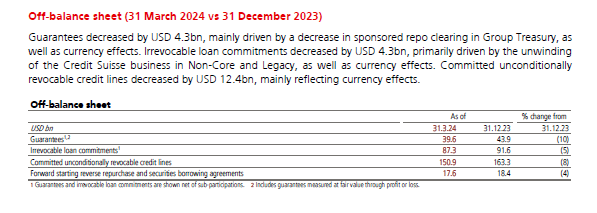
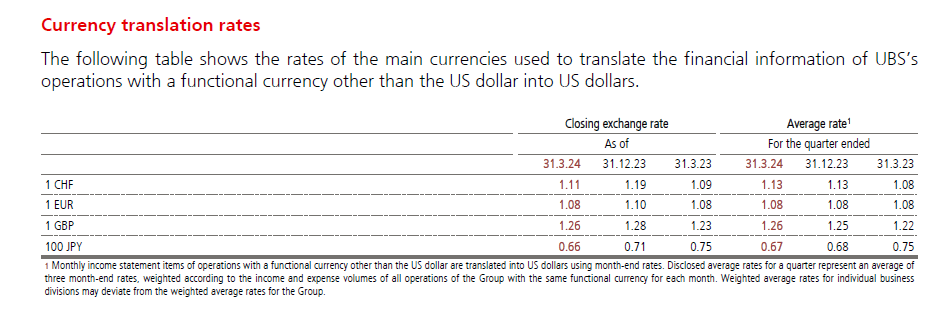
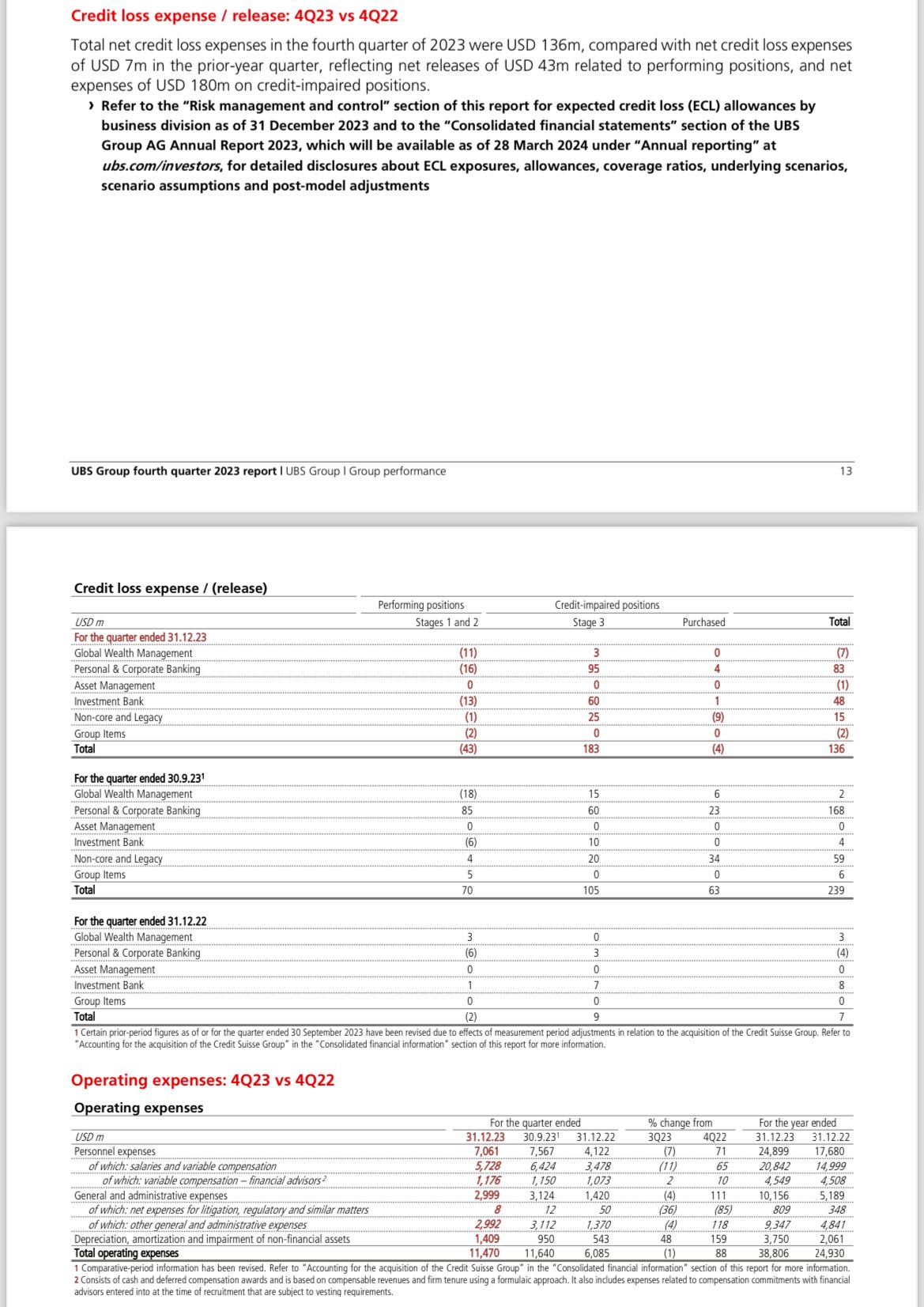
Oops, someone screwed up the accounting big time here… Now, when a bank is insolvent, what does the bank try to do to hide it? Of course, it will inflate the value of its assets to make them appear greater than the liabilities. $UBS, contrary to all other banks out there that have been trying all they could to cut their lending risk, instead saw it increase by $36.4bn between loans and securities financing combined in its assets. Weird, isn't it? Well, it's even weirder if you consider $UBS didn't make new loans but actually cut on lending exposure as remarked several times across its report. So how the heck did that value (conveniently) blow up? We find the answer in the "Leverage Ratio Denominator" section where $UBS claims "During the fourth quarter of 2023, the LRD increased by USD 79.6bn to USD 1,695.4bn, driven by currency effects of USD 68.4bn and asset size and other movements of USD 11.1bn" (Picture 2). Here's the thing, either $UBS forgot to hedge its FX risk and got lucky, or there is something wrong here (cough cough some accounting cheating perhaps?). Of course, there is something wrong here because no risk manager will allow its bank treasury to carry such an amount of FX risk in its books. Imagine if the swing happened in the wrong direction, that alone could easily wipe out most of the $87.8bn of equity in $UBS's balance sheet! What about off-balance sheet items? Please do me a favour and compare Picture 2 and 3 here, what do you see? Of the $317.2bn of $UBS Off-Balance sheet liabilities, only $79.9bn are considered in the Leverage Ratio Denominator calculation  I mean, is this a joke or what?! Let's conclude with something obvious at this point. Of course, as you can see in Picture 4, $UBS sees absolutely no credit risk whatsoever in its books and only accounted for $136m of credit losses in Q4-23. 

As I wrote last week (post below), $NYCB's troubles really sounded like the canary in $UBS's coal mine. Now that $UBS's financials are out, we can barely hear the canary singing…