Licencia Creative Commons

Showing posts with label 7 DE MAYO DE 2024. Show all posts

Monday, May 20, 2024

RETIRADA POR LA COMISIÓN EUROPEA DE LA AUTORIZACIÓN DE LA VACUNA Vaxzevria - COVID-19 (AstraZeneca) (II)

 Astra Zeneca withdrew their Covid vaccine Vaxzevria, from the global market. 

We were told it was due "to the application submitted by AstraZeneca AB on 5 March 2024 with a view to the withdrawal of the marketing authorisation for the medicinal product "Vaxzevria - COVID-19 Vaccine (ChAdOx1-S [recombinant])", . 

Just prior to its withdrawal the European Medicine's Agency received the data from the 2 year follow up Astra Zeneca safety and efficacy trial.


Clinical Trial Results:
A Phase III Randomized, Double-blind, Placebo-controlled Multicenter Study in Adults to Determine the Safety, Efficacy, and Immunogenicity of AZD1222, a Non-replicating ChAdOx1 Vector Vaccine, for the Prevention of COVID-19

Alguna información significativa de la prueba y de los resultados :

Recipientes vacuna: 21.587

Recipientes "placebo": 10.793

Efectos adversos serios:

Vacuna: 621 (1 de cada 34,76 participantes); "Placebo": 136 (1 de cada 39,68)

Efectos adversos atendidos médicamente:

Vacuna: 4.750 (1 de cada 4,54 participantes); "Placebo": 1256 ( 1 de cada 4,29)

Efectos adversos de especial interés:

Vacuna: 2.516 (1 de cada 8,57 participantes); "Placebo":  591 (1 de cada 9,13)

Total efectos adversos

Vacuna: 7.887 ( 1 de cada 2,73 participantes); Placebo: 1.983 ( 1 de cada 2,72 participantes)

La incidencia es superior en la vacuna al "placebo"

La incidencia de la infección Covid en el grupo de vacuna y en el de "placebo" es también similar y más favorable en el grupo del "placebo":

¿Tiene sentido la autorización de la EMA después de los resultados publicados?


Global Advisory Committee on Vaccine Safety (GACVS) review of latest evidence of rare adverse blood coagulation events with AstraZeneca COVID-19 Vaccine (Vaxzevria and Covishield) 

16 April 2021

Statement
Reading time: 2 min (665 words)

AstraZeneca formally admits that its COVID-19 vaccine can cause rare side effect In court documents, AstraZeneca has admitted for the first time that its covid vaccine can cause a rare side-effect. 

 Posted on 30 April 2024 

The admission is confirmed by AstraZeneca in legal documents responding to a group action claim launched by Leigh Day partner Sarah Moore under section 2 of the Consumer Protection Act 1987 against the pharmaceutical giant, AstraZeneca. It is expected that the claims could be worth millions of pounds.

Fifty-one claimants represented by Sarah are pursuing the claim due to injuries allegedly caused by the Vaxzevria Astra Zeneca COVID-19 Vaccine manufactured by AstraZeneca UK Limited (AZUK). Twelve of the claimants are acting on the behalf of a loved one who died following a complication allegedly caused by the vaccine.

All twelve of the bereaved claimants have received death certificates or medical evidence that confirms that the AZUK vaccine caused the deaths and injuries suffered by their loved ones.

The claimants say that they, or their loved one, suffered Vaccine Induced Immune Thrombosis with Thrombocytopenia (VITT) which is a form of Thrombosis with Thrombocytopenia Syndrome (TTS) as a direct result of the AZUK vaccine. This is a rare syndrome characterised by blood clotting and insufficiency of platelets.

TTS can have life-threatening consequences including strokes, brain damage, heart attacks, pulmonary embolism (a blockage of an artery in the lungs) and amputation.

Although AstraZeneca has disputed the claims, a legal document submitted to the Court to clarify their defence in February this year stated that its vaccine “can, in very rare cases, cause TTS.”


Wednesday, May 8, 2024

LA REVISIÓN DE LOS RESULTADOS DE UBS, Q1-24 RESULTS REVIEW - JustDario

UBS Q1-24 RESULTS REVIEW - THE “LA LA LAND” BANK - JustDario: “UBS swings back to profit and smashes earnings expectations for the first quarter”, was the CNBC headline shortly after #UBS Q1-24 results announcement. But what about all other MSM? Everyone, of course, is jumping on the same celebratory bandwagon. I wonder how many of these people influencing markets and sentiment...

  #UBS is recognizing the gross revenues from #CS business EXCLUDING any negative effect from marking to market the assets acquired to their market value.

As if this wasn’t enough of a joke by itself, as a cherry on top of the cake #UBS is also excluding losses from their investment in SIX Group (the Swiss Stocks Exchange)


#UBS greatly understated Risk Weighted Assets (RWA) So #UBS holds a total of 1,607bn$ in assets and reports 546m$ of RWA, what’s wrong with that? Only 301bn$ of #UBS loans (605bn$) are guaranteed by any form of collateral.

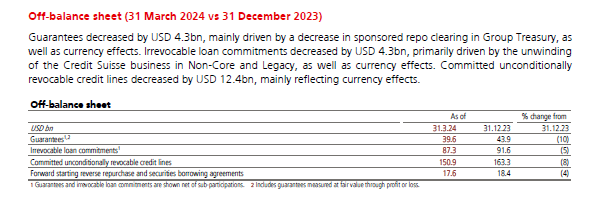
Ah, one more thing, #UBS also has 295bn$ of OFF-BALANCE SHEET assets

If we include this amount in our RWA calculation the result is ~46.5% assessment on their completely unsecured risk positions. Yes, that’s quite a lot of stretching.

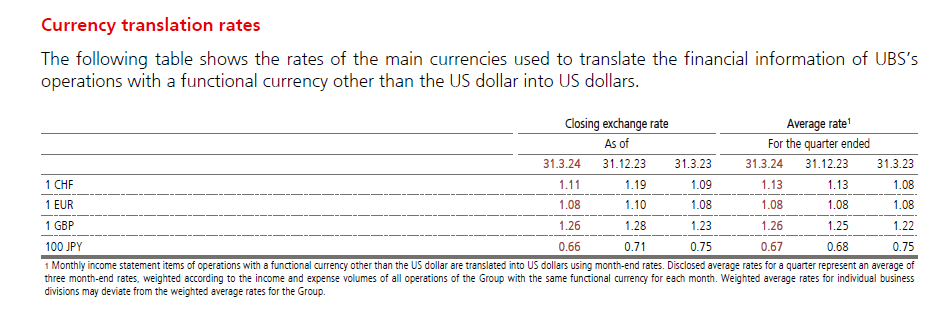
  – After we saw #HSBC doing that last week in “IS HSBC CEO “UNEXPECTEDLY” LEAVING BECAUSE THE BANK WON’T BE ABLE TO HIDE ITS PROBLEMS FOR MUCH LONGER?”, completely defying the laws of financial markets gravity even #UBS did not include any FX impact whatsoever in their Q1-24 results. No further comments are needed here.

 – What about Expected Credit Losses (ECL)? As you can see, #UBS is very optimistic about the future of the US and Swiss economies to the point that not only they IMPROVED their baseline expectations (picture 1), but they also completely removed a “Global Crisis” scenario from the projections in Q1-24 (picture 2). All this resulted in a meager 106m$ put aside for ECL and no, I am not joking.

 – Why is the Swiss Central Bank suddenly asking #UBS to increase their capital by ~25bn$ as per the “Swiss central bank calls for more capital rules after Credit Suisse saga” quickly forgotten “breaking news” from 2 weeks ago?

Reason 1: #UBS has a chronic hole in their brokerage business

...

 Reason 2: #CS’s “Negative Goodwill” of 27.7bn$ that was booked 2 quarters ago after applying its own “mark to market” to #CS assets marking a “historical” profit for a bank might not have been that positive after all (negative goodwill increases the revenues and assets in financial statements). What happens if those assets are worth 27.7bn$ less and #UBS’s CET1 capital instead of 78.7bn$ is 51bn$? Well… that will shrink their CET1 capital to 9.3%. What is the absolute minimum capital requirement for a G-SIB bank like #UBS (without considering increments because of the size)? 10%. There you go.

So basically #UBS is already under-capitalized because of #CS real asset values, still assuming their “La La Land” mark to markets on the rest of their books and the Swiss Regulator clearly knows it. Furthermore, this even excludes the “hole” we discovered in the #UBS brokerage business. I bet the regulator is aware of it too, hence the sudden “urgency” that is scaring off the bank’s management. What if we combine the 2? Well… #UBS’s CET1 will fall below the 8% absolute minimum requirement in the blink of an eye.

As I write, #UBS shares are trading up 8% celebrating the great Q1-24 results, I wonder if you agree with that now that you have read this article.

...

 Trust me, no one would be selling you something if they thought they would be getting a good deal out of it first. This is why I find it very hilarious to see investors buying shares of companies where their management consistently exercises their stock options and then liquidates the stocks shortly after in the market. I find it even more hilarious to see investors buying stocks of companies that consistently perform share buybacks in the market when prices are expensive, not the opposite. Isn’t this counterintuitive? With all the insider information they have, the management should be buying back stocks of their own company when these are cheap, not the opposite, right? Well… but when the stock is at the top, it’s the best time to cash out their bonuses paid in shares…

Feel free to disagree with me, but we’ve come to a point where investors are acting in the market against their own interests without realizing how their actions are counterintuitive in their nature. We’ve even seen extremes equivalent to investors buying a used car that was being set on fire in the parking lot. Why? Because they knew there is a buyer lining up right behind them that is willing to buy that too so if they bid first they could then resell it at a higher price, making a profit in the process.

How could all of this be sustainable and end well?


Monday, May 6, 2024

RETIRADA POR LA COMISIÓN EUROPEA DE LA AUTORIZACIÓN DE LA VACUNA Vaxzevria - COVID-19 (AstraZeneca)

 THE EUROPEAN COMMISSION,


Having regard to the Treaty on the Functioning of the European Union,


Having regard to Regulation (EC) No 726/2004 of the European Parliament and of the Council of 31 March 2004 laying down Union procedures for the authorisation and supervision of medicinal products for human use and establishing a European Medicines Agency1,


Having regard to the application submitted by AstraZeneca AB on 5 March 2024 with a view to the withdrawal of the marketing authorisation for the medicinal product "Vaxzevria - COVID-19 Vaccine (ChAdOx1-S [recombinant])",


Whereas:


(1) The placing on the market of the medicinal product "Vaxzevria - COVID-19 Vaccine (ChAdOx1-S [recombinant])", which is entered in the Union Register of Medicinal Products under the number EU/1/21/1529 was authorised by Commission Decision C(2021) 698(final) of 29 January 2021.


(2) Following the holder's request, that authorisation should be withdrawn,


HAS ADOPTED THIS DECISION:


Article 1


At the holder's request, the marketing authorisation granted by Decision C(2021) 698(final) of 29 January 2021 for the medicinal product "Vaxzevria - COVID-19 Vaccine (ChAdOx1-S [recombinant])" is withdrawn.


Article 2


The withdrawal referred to in Article 1 shall be applicable with effect from 7 May 2024.