Licencia Creative Commons

Friday, September 16, 2011

LA LIQUIDEZ Y LA CRISIS DEL SISTEMA MONETARIO EUROPEO


Uno de los problemas más graves de Europa es que los verdaderos debates sobre la situación actual de la crisis del sistema monetario tienen lugar, más frecuentemente, fuera de sus fronteras.

Así lo pone de manifiesto el comentario y los cuadros del mismo aquí reproducidos, después de que la crisis haya sido dilatada de nuevo con el nuevo programa de liquidez de los bancos centrales a los bancos de la eurozona.

El comentario se refiere, agudamente, al momento “Lehman” europeo y a la envergadura y aparente imposibilidad de un programa como el TARP americano a nivel europeo.

“The most scathing report describing in exquisite detail the coming financial apocalypse in Europe comes not from some fringe blogger or soundbite striving politician, but from perpetual bulge bracket wannabe, Jefferies and specifically its chief market strategist David Zervos.

The bottom line is that it looks like a Lehman like event is about to be unleashed on Europe WITHOUT an effective TARP like structure fully in place. Now maybe, just maybe, they can do what the US did and build one on the fly - wiping out a few institutions and then using an expanded EFSF/Eurobond structure to prevent systemic collapse. But politically that is increasingly feeling like a long shot. Rather it looks like we will get 17 TARPs - one for each country. That is going to require a US style socialization of each banking system - with many WAMUs, Wachovias, AIGs and IndyMacs along the way. The road map for Europe is still 2008 in the US, with the end game a country by country socialization of their commercial banks. The fact is that the Germans are NOT going to pay for pan European structure to recap French and Italian banks - even though it is probably a more cost effective solution for both the German banks and taxpayers....Expect a massive policy response in Europe and a move towards financial market nationlaization that will make the US experience look like a walk in the park. " Must read for anyone who wants a glimpse of the endgame. Oh, good luck China. You'll need it.”

Esta es la historia completa

Wednesday, September 14, 2011

WOLF: LA INEVITABLE ELECCION DE ALEMANIA

http://www.ft.com/cms/s/0/fdb8cb90-ddf0-11e0-a391-00144feabdc0.html#ixzz1XxOa5wEL

1) La opción menos mala sería que el Banco Central Europeo asegurara la liquidez de los Estados e instituciones financieras solventes.No debería ser intelectualmente difícil argumentar que la compra de deuda es compatible con una estabilidad financiera continuada, puesto que la base monetaria ha estado creciendo a un mero 2 por ciento anual.

2) ¿Qué debería suceder si el gobierno alemán decidiera que no podía apoyar tal acción?.El Banco Central Europeo debería ir adelante con ella antes que permitir que un colapso en cascada se disparara. Entonces Alemania tendría la opción de abandonar el euro, quizás con Austria, Holanda y Finlandia.

3) En una crisis tan amenazadora para Europa y el mundo, la institución europea con la capacidad de actuar en la escala adecuada debería atreverse a hacerlo, puesto que los costes de no hacerlo así serían devastadores.Ello daría lugar seguramente a una crisis política, pero esta sería preferible a la crisis financiera desatada por el fracaso en la actuación requerida.

4) Al final Alemania debe elegir entre una eurozona muy diferente de la más grande esperada o ninguna eurozona en absoluto.Reconozco cuánto deben odiar sus líderes y ciudadanos verse obligados a resolver sobre esta alternativa.Pero esta es la que encuentran frente a ellos.La Canciller Angela Merkel debe ahora atreverse a decidir, clara y abiertamente.


martin.wolf@ft.com

Copyright The Financial Times Limited 2011.

Sunday, September 11, 2011

EUROPA AL BORDE DE UN COLAPSO POLITICO

Europe on the Verge of a Political Breakdown - Barry Eichengreen - Project Syndicate

“But Europe doesn’t have months, much less years, to resolve its crisis. At this point, it has only days to avert the worst. It is critical that leaders distinguish what must be done now from what can be left for later.

The first urgent task is for Europe to bulletproof its banks. Doubts about their stability are at the center of the storm. It is no coincidence that bank stocks were hit hardest in the recent financial crash.

There are several ways to recapitalize Europe’s weak banks. The French and German governments, which have budgetary room for maneuver, can do so on their own. In the case of countries with poor fiscal positions, Europe’s rescue fund, the European Financial Stability Facility, can lend for this purpose. If still more money is required, the International Monetary Fund can create a special facility, using its own resources and matching funds put up by Asian governments and sovereign wealth funds.

The second urgent task is to create breathing space for Greece. The Greek people are making an almost superhuman effort to stabilize their finances and restructure their economy. But the government continues to miss its fiscal targets, more because of the global slowdown than through any fault of its own.

This raises the danger that the EU and IMF will feel compelled to withdraw their support, leading to a disorderly debt default – and the social, political, and economic chaos that this scenario portends. In Greece itself, political and social stability are already tenuous. One poorly aimed rubber bullet might be all that is needed to turn the next street protest into an outright civil war.

Again, help can come in any number of ways. Creditors can agree to relax Greece’s fiscal targets. The limp debt exchange agreed to in July can be thrown out and replaced by one that grants the country meaningful debt relief. Other EU countries, led by France and Germany, can provide foreign aid. Those who have spoken of a Marshall Plan for Greece can put their money where their mouths are.

(…)

The third urgent task is to restart economic growth. Financial stability, throughout Europe, depends on it. Without growth, tax revenues will remain stagnant, and the capacity to service debts will continue to erode. Social stability, similarly, depends on it. Without growth, austerity will become intolerable.

Here, too, the problem has several solutions. Germany can cut taxes. Better still would be coordinated fiscal stimulus across northern Europe.

But the fact of the matter is that northern European governments, constrained by domestic public opinion, remain unwilling to act. Under these circumstances, the only practical source of stimulus is the ECB. Interest rates will have to be slashed, and the ECB will have to follow up with large-scale asset purchases like those recently announced by the Swiss National Bank.

(…)

European leaders’ continued focus on the long run at the expense of short-term imperatives may indeed be the death knell for their single currency."

Barry Eichengreen


Saturday, September 10, 2011

LA MEJOR ESTRATEGIA DE RESCATE DEL EURO


El artículo de Harald Hau que se transcribe, que tiene por introducción el título "Por qué Lagarde acierta", describe muy adecuadamente las alternativas disponibles en la hora de la verdad para el euro y las razones económicas y políticas por las que la recapitalización bancaria (largamente evitada) y no los eurobonos debría considerase la solución más adecuada a escala de la Unión.La crisis bancaria tampoco puede resolverse a nivel de los Estados miembros.

La insistencia "moral" en las culpas de los países de la periferia, y la falta de iniacitiva europea de los propios líderes nacionales, han impedido e impiden incluso la debida consideración de las respuestas necesarias a nivel europeo:


"Bank recapitalisation is the best euro rescue strategy

The latest proposed solution to the Eurozone crisis is Eurobonds. This column argues that such a move would be politically poisonous and would shift the losses of the continent’s richest to the taxpayer. Instead, Europe’s policymakers should follow the strategy outlined by the new IMF chief Christine Lagarde. She calls for the recapitalisation of banks so that they can absorb the worst of the losses should Eurozone countries default.

"Those who seek to defend everything defend nothing"
Prussian Reformer and General Gerhard von Scharnhorst.

The quote above is a fair characterisation of the policy response of European heads of state and the ECB to Europe's sovereign debt crisis. A new strategy is needed. Instead of trying to avoid sovereign default, at staggering costs to the European taxpayer, policymakers need to focus directly on capital measures for European banks – a much more credible, cheaper, and defendable policy.

The May 2010 Greek policy was a mistake

It is increasingly clear that avoiding the default of Greece and the creation of the European Financial Stability Facility (EFSF) was a big policy mistake (see Wyplosz 2010 and 2011). Some bank economists and bond investors have done their best to manipulate public opinion and, surprisingly, many confused journalists have echoed the narrow self-interest of exposed capital-market investors. But now that the insolvency of larger countries like Spain or even Italy seems possible, the ECB doctrine of "no European sovereign default" becomes simply untenable.

European guarantees for Spanish or Italian public debt are just unacceptable to the French, German, or Dutch taxpayer because of the magnitude of the risk involved.

  • The Finns have already said their farewell to the Greece rescue plan and they cannot be blamed their good common sense.
  • When the full financial burden of EFSF guarantees falls upon the German taxpayer over the next three years, it will become evident that Chancellor Merkel has led her Christian democratic party down a road to political suicide.

Eurobonds not the solution

Some believe a Eurobond could rescue the situation, but this is akin to magical thinking. A Eurobond is just shifting the problem to those countries which still enjoy capital market access (see Alesina and Giavazzi 2011).

  • Eurobonds would bring neither debt relief nor any new fiscal resources to the table.
  • The claim that the Eurobonds could be traded for more fiscal austerity and/or constitutional limits on further debt are delusional.

Such commitment will mostly exist on paper, given low levels of government effectiveness and rule of law in some periphery countries (Gros 2011). Peer monitoring at the European level has already failed, as seen in the violation of the Maastricht criteria, the Lisbon Agenda, and so on.

Eurobonds: A bundle of nails for the euro coffin

The central problem of the Eurozone turned out to be not the asymmetric shocks predicted by many euro-sceptic economists in the 1990s, but its corrosive effect on fiscal discipline.

  • When the newly-elected French president Mitterrand embarked on a fiscally-irresponsible spending spree in 1981, the German mark-French franc currency peg immediately came under pressure and forced a policy change within 6 months.
  • The common currency has essentially prolonged the time of reckoning.

A common Eurobond would sweep away the last remnants of fiscal discipline, a sort of death verdict for the common currency through soft budget constraints.

However, the common currency is defendable at least for the core countries. Yet, whatever scarce fiscal resources there are need to be focused on bank recapitalisation instead of on bailing out all investors. Indeed, orderly sovereign default need not have catastrophic economic consequences if the banking sector is sufficiently capitalised to absorb losses from sovereign default.

We therefore need a mandatory large-scale recapitalisation of European banks to a level of equity capital that allows them to absorb further sovereign defaults and debt write-downs, as recently proposed by new IMF chief Christine Lagarde (see Harding 2011 in the Financial Times). Such a defence of the euro is in the common interest and feasible (because only a fraction of Europe's sovereign debt is owned by banks).

Public recapitalisation gives taxpayers a stake in the upside

In return for new equity capital, the taxpayer should get equity shares, which means that he/she stands a good chance of breaking even in the long run when these shares are sold back to the capital market. In Sweden and Switzerland, such sales netted handsome government profits. Expected bank losses from sovereign default will be priced into the new bank shares so that the taxpayer gets a fair deal and existing equity owners take the loss. The disciplining role of the capital market is fully restored – bank valuations will suffer only to the extent to which they took on sovereign default risk.

Such an alternative plan would concentrate the financial losses with those most responsible for the credit misallocation, namely specific bank capital owners and owners of sovereign credit. By contrast, the wholesale bailouts of Greece, Ireland, and Portugal would all socialise private losses. Moreover, this socialisation of private losses implies a gigantic redistribution of wealth to the 5% richest in the world who own roughly 70% of all financial assets and, by extension, own a similar percentage of the private losses (Hau 2011). Ironically, the current rescue plans for Greece unburden the capital market investors most capable of taking large losses – indeed, the so-called private sector involvement is largely a farce (Cabral 2011).

A debt crisis and a competitiveness crisis: Different causes and solutions

It should also be highlighted that a debt crisis and a competitive crisis are distinct problems. The Irish and the Italian states might become insolvent, but that does not imply that either economy is in need for a nominal devaluation and therefore needs to leave the Eurozone. Default by more European countries (other than Greece) does not imply the demise of the euro as sometimes claimed. In fact, orderly sovereign default - while shielding the banking sector through mandatory recapitalisation - may offer a fast track exit from the current debt crisis and be the best chance for the euro's survival and a fast recovery. It certainly forces instant fiscal adjustment to a balanced budget without any attacks on fiscal sovereignty which can only poison European politics.

Conclusion

A major obstacle to such a solution is the banking and capital market lobby - they like Eurobonds as the best way to socialise private losses. Chancellor Merkel should therefore expect a lot of scapegoating in the months ahead. But her true shortcoming so far is the failure to prepare a workable line of defence for the euro - one that would allow for sovereign default but would simultaneously avoid a European banking crisis. That means focusing on a mandatory bank recapitalisation.

Harald Hau

2 de Septiembre de 2011

References

Alesina, Alberto and Francesco Giavazzi (2011), “Why a slowdown in Germany could be good for Europe”. VoxEU.org, 1 September.
Cabral, Ricardo (2011), "Greece’s 2nd bailout: Debt restructuring with no debt reduction?", VoxEu.org, 29 July.
Gros, Daniel (2011), "Eurobonds: Wrong solution for legal, political, and economic reasons", VoxEu.org, 24 August.

Harding, Robin (2011), "Lagarde calls for urgent action on banks", Financial Times, August 27.
Hau, Harald (2011), “Europe’s €200 billion reverse wealth tax explained”, VoxEU.org, 27 July.
Wyplosz, Charles (2010), “And now? A dark scenario”, VoxEU.org, 3 May.
Wyplosz, Charles (2011), “They still don’t get it”, VoxEU.org, 22 August.

COPYRIGHT VOXEU.ORG


Friday, September 9, 2011

LA SUPERVIVENCIA DE LA EUROZONA SEGUN MUNCHAU


Unless there is a dramatic and simultaneous shift in the politics of Italy, Germany and the European Central Bank, the collapse of the eurozone is all but certain. Neither Italy, Spain, Portugal, Ireland nor Greece will be able to maintain their membership in the eurozone, and maintain sustainability of their sovereign debt at current interest rate spreads. Something will have to give. The collapse of equity and sovereign bond prices is testimony that investors have lost trust in the process.

The extremely grave situation is the result of a multitude of factors: the original sin of a monetary union with no complement of an economic union; poor economic policies in several member states, including Italy; the German establishment’s collective embrace of neo-classical economics; and also market failure. There is no point now in assigning blame. We must look ahead. To solve the crisis will require a gargantuan political effort on all sides. The bad news is that neither Rome, nor Berlin, nor Frankfurt is politically prepared.

To get of out this mess would take three ingredients. The first is, of course, a eurobond, as an instrument of permanent interest rate convergence. On this point, Giulio Tremonti is right. As long as Germany maintains its opposition, the crisis will continue. The ruling of the German constitutional court, seems to rule out this prospect, and has significantly reduced the probability of a eurozone bond. Politically, opposition to eurobonds has also strengthened within Germany. Even Wolfgang Schäuble, the finance minister, and the most pro-European member of Angela Merkel’s cabinet, has firmly and publically ruled them out, or any other form of joint and several liability as a crisis resolution mechanism. This is very bad news.

(...)

The second ingredient is a partial loss of sovereignty. In European politics, everything is a contract. Just as Germany is not prepared for a Eurobond, Italy is not prepared for the deep political changes that a Eurobond would entail. Both will have to move. A transfer of sovereignty means that the main parameters of macroeconomic policy would be set outside the country. The size of the “manovra” would be determined externally, and even its distribution would be subject to negotiations with European partners. Under a eurobond regime, even distributional issues should be a matter of common concern, especially if countries choose economic policies that are detrimental to their ability to achieve growth and debt sustainability in the long run. While not necessary from the start, a monetary union will ultimately also require a common system of income and corporate taxes.

A third ingredient in such a system is a changed role of monetary policy. In the previous, depoliticised monetary union, the role of the central bank was clearly delineated. It was able to follow a simple inflation rule. But as a central bank in the world’s second largest economy, its task would become more multidimensional, as the task of Federal Reserve has become.

The crisis is certain to get worse, which may open up an opportunity for such a historic compact that would introduce a central eurozone executive in charge of macroeconomic policy, a eurozone bond, and a refined definition of the ECB’s mandate. I am not optimistic of any progress in the short term, given the extremely weak leadership in Germany and Italy. And in both countries, there will be no elections until 2013 that could force a regime change.

The needed changes are so complex that it would require the equivalent of a constitutional convention. We should be under no illusion that the introduction of these changes would involve serious changes to the European Treaties. It will have profound implication on the institutions of the European Union and their policies. A eurobond and its conjoint policy regime will take many years to agree, and implement.

The good news is that the eurozone does not need the eurobond itself to solve its crisis, only a credible process that leads to the creation of a eurobond eventually. Unfortunately, such a process is not imminent. I am starting to agree with Martin Luther: I hear the message well, but lack Faith’s constant trust.

Wolgang Munchau

The author is president of Eurointelligence, and an associate editor of the Financial Times.

LOS EUROBONOS SON NECESARIOS PERO NO SUFICIENTES

Wednesday, August 31, 2011

LO DAÑADOS CIMIENTOS DE EUROPA

La inestable situación de Europa - Joschka Fischer - Project Syndicate

UN DIAGNOSTICO CERTERO DEL EX-MINISTRO ALEMAN FISCHER

"Europa tiene tres alternativas. Una es seguir improvisando, como hasta ahora; el resultado no será otro que agravar y prolongar la crisis. Otra, eliminar la unión monetaria, lo que significaría el fin del proyecto europeo y el inicio de un caos ingobernable. La tercera y última opción sería que Europa avance en la dirección de una integración económica y política efectiva; pero los líderes actuales no se atreven a dar este paso, porque no creen que la opinión pública interna les dé el apoyo necesario.

De modo que todo indica que por ahora la respuesta será una combinación de las primeras dos opciones. Más tarde, cuando el proyecto europeo esté a medio naufragar, puede ser que llegue la hora del federalismo. Pero la palabra clave es “puede”: porque también puede perfectamente ocurrir que Europa se hunda en el abismo.

La inacción de Europa ante la crisis ya produjo consecuencias negativas palpables. La pasividad de los funcionarios electos atizó la desconfianza popular, que ahora es una amenaza para el proyecto europeo. De hecho, la crisis comienza a socavar los mismísimos cimientos en los que se basó el orden europeo de posguerra: la alianza francoalemana, por un lado, y la transatlántica, por el otro, que hicieron posible un período de paz y prosperidad sin precedentes en la historia del continente.

La presión de los mercados financieros ya está sobre Francia, y el peligro que plantea apenas ha comenzado. Si Francia es incapaz de resistir y Alemania no se decide a jugar todas sus cartas en defensa de su socio, la catástrofe europea será completa. Y puede suceder muy pronto: los franceses no pueden dejar la región del Mediterráneo abandonada a su suerte (y no lo harán), de modo que las fantasías que abrigan los europeos ricos del norte (sobre todo, los alemanes), respecto de que estos países se salgan de la zona, ponen en riesgo el pilar francoalemán del que depende la paz europea."


Tuesday, August 30, 2011

ALGUNAS PREDICCIONES PARA EL RESTO DE LA DECADA

EconoMonitor : EconoMonitor » Some Predictions for the Rest of the Decade


"My basic sense is that we are at the end of one of the six or so major globalization cycles that have occurred in the past two centuries. If I am right, this means that there still is a pretty significant set of major adjustments globally that have to take place before we will have reversed the most important of the many global debt and payments imbalances that have been created during the last two decades. These will be driven overall by a contraction in global liquidity, a sharply rising risk premium, substantial deleveraging, and a sharp contraction in international trade and capital imbalances."

MPetiss

LAS PREDICCIONES DE MICHAEL PETTIS SON LAS SIGUIENTES:


*BRICS and other developing countries have not decoupled in any meaningful sense, and once the current liquidity-driven investment boom subsides the developing world will be hit hard by the global crisis.


* Over the next two years Chinese household consumption will co
ntinue declining as a share of GDP.


* Chinese debt levels will continue to rise quickly over the rest of this year and next.


* Chinese growth will begin to slow sharply by 2013-14 and will hit an average of 3% well before the end of the decade.


* Any decline in GDP growth will disproportionately affect investment and so the demand for non-food commodities.


* If the PBoC resists interest rate cuts as inflation declines, China may even begin slowing in 2012.


* Much slower growth in China will not lead to social unrest if China meaningfully rebalances.


* Within three years Beijing will be seriously examining large-scale privatization as part of its adjustment policy.


* European politics will continue to deteriorate rapidly and the major political parties will either become increasingly radicalized or marginalized.


* Spain and several countries, perhaps even Italy (but probably not France) will be forced to leave the euro and restructure their debt with significant debt forgiveness.


* Germany will stubbornly (and foolishly) refuse to bear its share of the burden of the European adjustment, and the subsequent retaliation by the deficit countries will cause German growth to drop to zero or negative for many years.


* Trade protection sentiment in the US will rise inexorably and unemployment stays high for a few more years.


Cada una de las predicciones anteriores es cuidadosamente expuesta y argumentada en detalle por el autor en su trabajo


Sunday, August 28, 2011

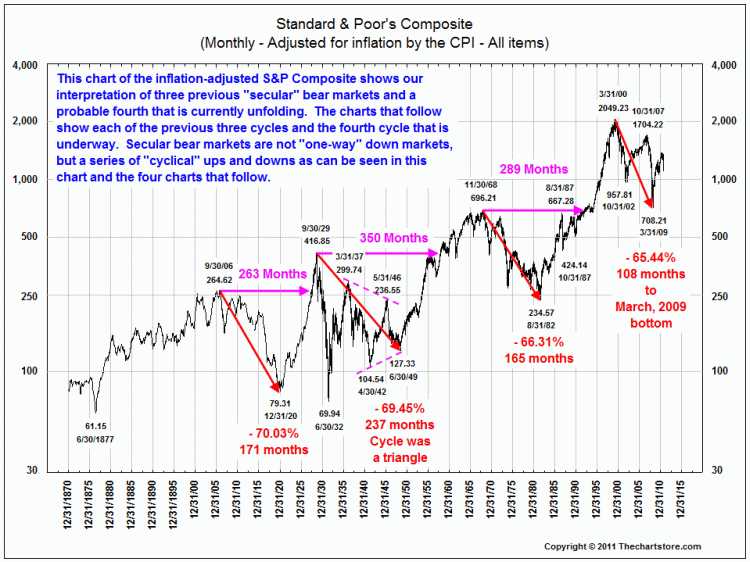
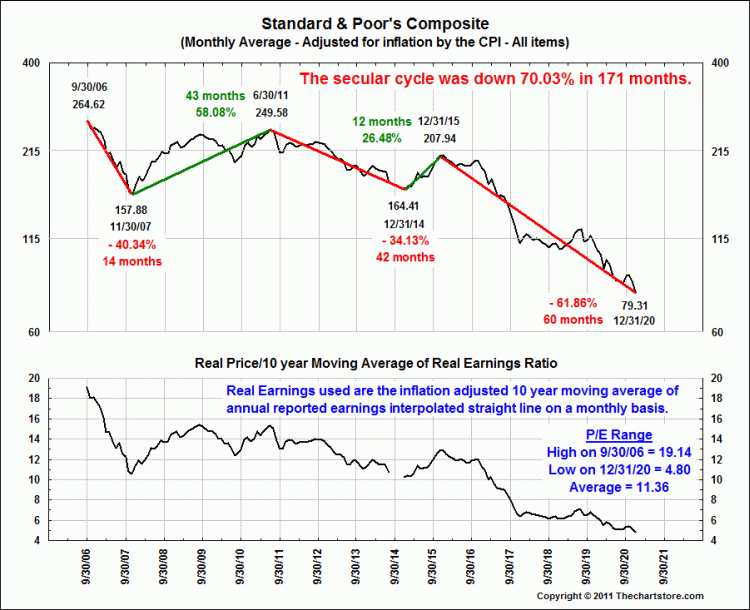
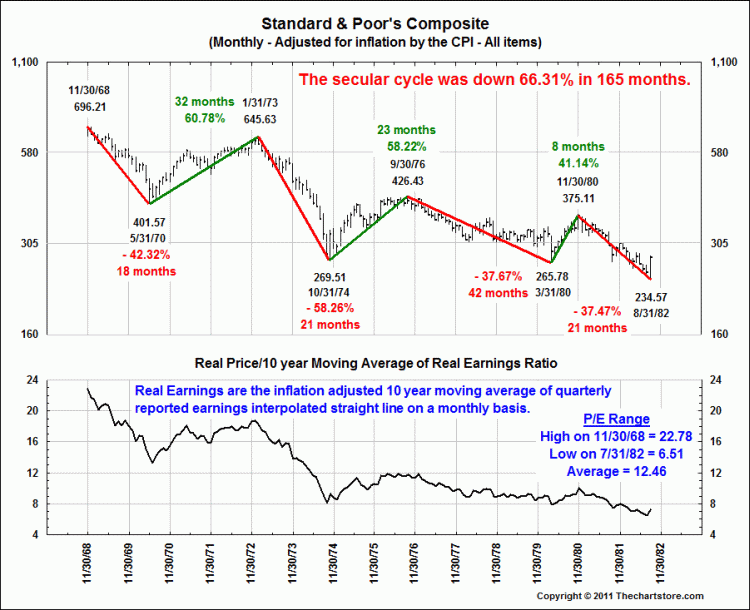
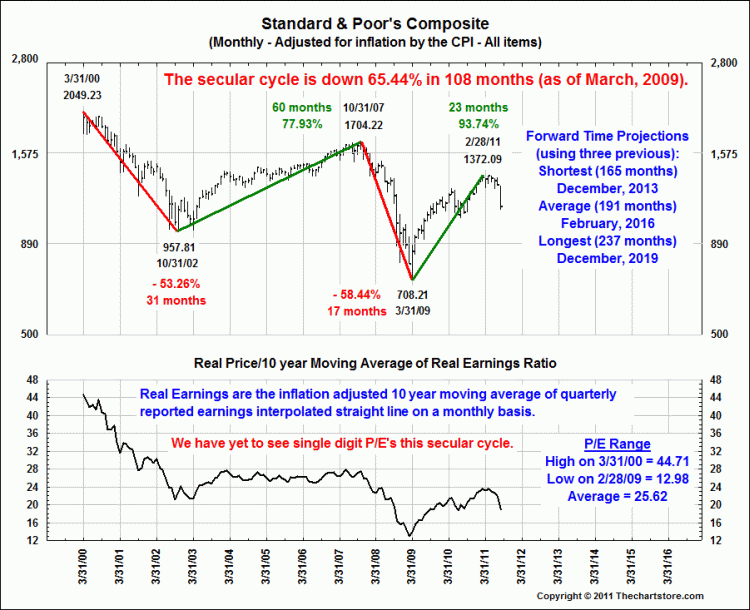
SERIES HISTORICAS DE MERCADOS BAJISTAS


Los gráficos de Ron Griess deberían decir algo sobre mercados, precios y valoración a quien los lea y - ¿sería mucho pedir?- a los "brujos" de nuestros días, representantes eximios de lo que, una vez, Marx calificó como "el corazón de un mundo sin corazón".Las series abarcan de 1871 a 2011.

˜˜˜

˜˜˜

˜˜˜

˜˜˜

˜˜˜

Estan publicadas en The Chart Store

Este es el documento separado

Friday, August 26, 2011

CAOS O EQUILIBRIO EN LOS MERCADOS DE CAPITALES


En una entrevista publicada por Spiegel el 25 de Agosto, Paul Woolley del Centro para el Estudio de la Disfuncionalidad del Mercado de Capital se pronuncia de la forma siguiente sobre las cargas impuestas por las ineficiencias del Mercado de Capital:

Financial markets are inefficient and growing to the point of overwhelming the economy, according to Paul Woolley, an expert on market dysfunctionality. In an interview with SPIEGEL he explains why it's up to investors to stop dangerous trends and hold financial institutions accountable.

"SPIEGEL: Mr. Woolley, you were fund manager for many years, but went on to found a research institute at the London School of Economics to study why financial markets repeatedly go haywire. Now speculators are once again betting against the euro, and share prices for big companies are falling by 20 percent in a day only to shoot back up again. What is going on?

Woolley: The developments in recent weeks have made it quite clear that the markets don't function properly. Things are spinning out of control and are potentially dangerous for society. Only a fraternity of academic high priests connected to the finance markets is still speaking of efficient markets. Still each market participant is pursuing their own selfish interests. The market isn't reaching equilibrium -- it's falling into chaos.

(…)

SPIEGEL: Why did you leave the finance industry in 2006, then?

Woolley: I wanted to do something socially useful. We want to revolutionize the finance industry with our institute. You have to build into the models and the self interests of the banks and fund managers to which the most investors have delegated their investment decisions. The finance industry is characterized by many innovations. Because the customers hardly understand their innovative products, banks make amazing returns. But simultaneously there is a moral hazard: When something goes wrong the bankers just move on to the next employer. The banks bear the losses. Or, in the case of bankruptcy, the state takes on the costs.

SPIEGEL: Governments are trying to curb the financial industry. What are their chances?

Woolley: I'm skeptical about this. There are many incentives for banks to get around the rules. Sanctions won't help in the long run.

SPIEGEL: You rely on the insight of the investors, then?

Woolley: Right. The big investors are in a position to force their service providers, the banks, fund managers and bankers into better behaviour. I have developed 10 simple rules that big investors should introduce for their own interests. After all, average returns on pension funds worldwide, for example, have decreased repeatedly after the market crashes in recent years.

SPIEGEL: What should investors take to heart from these 10 rules?

Woolley: They should stop chasing short-term price changes, and instead take a long-range approach to investing. That's why they should cap annual turnover of portfolios at 30 percent per annum. They should stop paying performance fees to managers who increase the worth of funds because it encourages gambling. It is nearly impossible to assess whether above average returns come from a manager's skill, luck or market moves.

SPIEGEL: What can insurers and other large investors do additionally to contain the excesses of the financial markets?

Woolley: They shouldn't invest in hedge funds or private equity companies. Managers at these companies are particularly good at hiding high costs to enrich themselves. To generate returns they must take on significantly higher risks. Big investors should also insist that trading take place on a public market. Bank profits would sink almost automatically if they were no longer allowed to sell opaque products."

Interview conducted by Christoph Pauly


Saturday, August 20, 2011

ARE WE APPROACHING THE ENDGAME FOR THE EURO?

New Economic Perspectives: ARE WE APPROACHING THE ENDGAME FOR THE EURO?: By Marshall Auerback Forget about the S&P downgrade, which has had ZERO impact on the global equity markets. The downgrade was supposed...

Friday, August 12, 2011

PROHIBICION DE POSICIONES CORTAS SOBRE ACCIONES


ESTE ES AL ACUERDO DE LA CNMV ESPAÑOLA:

"11 de agosto, 2011

La situación de extrema volatilidad que atraviesan los mercados de valores europeos, en especial las cotizaciones de acciones de entidades financieras, está incidiendo de forma clara en la estabilidad de los mercados y puede perturbar su ordenado funcionamiento. En estas condiciones resulta preciso revisar la operativa de los mercados de valores con el fin de asegurar el mantenimiento de la estabilidad financiera.

Teniendo en cuenta lo anterior y las medidas similares que otros supervisores europeos están impulsando de manera coordinada en el ámbito de ESMA, la CNMV acuerda:

Prohibir de forma cautelar con efectos inmediatos y con carácter transitorio, al amparo del artículo 85.2 j de la Ley 24/1988, de 28 de julio, del Mercado de Valores (LMV), la realización por cualquier persona física o jurídica de operaciones sobre valores o instrumentos financieros que supongan la constitución o incremento de posiciones cortas sobre acciones españolas del sector financiero.

La prohibición se mantendrá por un periodo de 15 días desde la fecha de hoy, pudiendo prorrogarse si se considerase necesario.

La prohibición cautelar afecta a cualquier operación sobre acciones o índices, incluyendo operaciones de contado, derivados en mercados organizados o derivados OTC, que suponga crear una posición corta neta o aumentar una preexistente, aunque sea de forma intradiaria. Se entenderá por posición corta aquella que resulte en una exposición económica positiva ante una caída del precio de la acción.

Se excluyen de la prohibición cautelar las operaciones que sean realizadas por entidades que desarrollen funciones de creación de mercado. Se entenderá por tales las entidades financieras o empresas de servicios de inversión que, como respuesta a órdenes de clientes o como resultado de cotizar precios de oferta y demanda de forma continua en su condición de miembros de mercados secundarios oficiales o sistemas multilaterales de negociación, incurran transitoriamente, especialmente intradía, en posiciones cortas.

Las acciones o cuotas participativas a las que se aplica este acuerdo son, a fecha actual:

Banca Cívica, S.A.

Banco Bilbao Vizcaya Argentaria, S.A.

Banco de Sabadell, S.A.

Banco de Valencia, S.A.

Banco Español de Crédito, S.A.

Banco Pastor, S.A.

Banco Popular Español, S.A.

Banco Santander, S.A.

Bankia, S.A.

Bankinter, S.A.

Caixabank, S.A.

Caja de Ahorros del Mediterráneo

Grupo Catalana de Occidente S.A.

Mapfre, S.A.

Bolsas y Mercados Españoles, S.A.

Renta 4 Servicios de Inversion, S.A.

Se recuerda que el artículo 99 quinquies de la LMV tipifica como infracción muy grave el incumplimiento de las medidas cautelares previstas, entre otras, en la letra j del artículo 85.2 de la Ley.

En Madrid, a 11 de agosto de 2011."

Medidas similares se han adoptado por Francia, Italia y Bélgica.

Se reproducen a continuación algunos comentarios sobre las medidas recogidos en Bloomberg:

British financial stocks dropped 41 percent in the four months after regulators imposed a ban on short selling following the collapse of Lehman Brothers Holdings Inc. in September 2008. The benchmark FTSE 100 index fell 15 percent in the period.

When the Securities and Exchange Commission prohibited short-sales for three weeks in September 2008 a Bloomberg Index tracking the 880 U.S. stocks affected fell 26 percent, outpacing the Standard & Poor’s 500 Index’s 22 percent decline.

Barclays Capital analysts wrote in a report to clients today. “Short-selling bans have proven ineffective in the past, tend not to address the real underlying issues in Europe, reduce liquidity and increase the related risk premiums.”

European lenders may be struggling to fund themselves. Banks’ overnight borrowings from the European Central Bank jumped to the highest in three months yesterday, a sign some lenders may need emergency cash. The difference between three- month Euribor and the overnight indexed swap rate, a measure of banks’ reluctance to lend to each other, was at 0.67 percentage point today, close to the widest spread since May 2009.

“EU policy makers don’t seem to understand the law of unintended consequences,” Jim Chanos, the short seller known for predicting Enron Corp.’s collapse, said by e-mail. “The vast majority of short-selling financial shares is by other financial institutions, hedging their counterparty risks, not speculators. The interbank lending market froze up completely in October to December 2008 -- after the short-selling bans.”

The ban won’t have its intended impact of helping banks, because money managers will also have to reduce wagers that financial stocks will rise, said Gemma Godfrey, who chairs the investment committee at Credo Capital Plc, a wealth manager in London. Without the ability to make corresponding bearish bets to mitigate risk, hedge funds will abandon the market, she said.

“It means hedge funds can’t manage their risk as well as they could before, so you are just increasing volatility,” said Godfrey, whose firm has 1.3 billion pounds ($2.1 billion) invested in hedge funds and other asset managers. “If they close out their shorts, they have to close out their longs.”

Short-selling prohibitions are meant to restore confidence among nervous traders, who incorrectly think that hedge funds have driven down share prices, said Andrew Shrimpton, who previously oversaw hedge funds at the U.K.’s Financial Services Authority. The bans don’t work, because they reduce trading volumes, which acerbates the price impact of selling, he said.

“They are going after the hedge fund bogeyman,” said Shrimpton, who’s now a partner at hedge-fund consultancy Kinetic Partners LLP in London. “We tried this once before in 2008, and proved beyond all doubt that it doesn’t work.”

BLOOMBERG: ESPAÑA, FRANCIA, ITALIA Y BELGICA PROHIBEN LAS POSICIONES CORTAS EN ACCIONES DE BANCOS

To contact the reporters on this story: Howard Mustoe in London at hmustoe@bloomberg.net; Jesse Westbrook in London at jwestbrook1@bloomberg.net

To contact the editor responsible for this story: Edward Evans at eevans3@bloomberg.net