Licencia Creative Commons

Friday, June 24, 2022

Dobbs v. Jackson Women’s Health Organization (24-06-2022: SCOTUS)

SUPREME COURT OF THE UNITED STATES 

Syllabus 

DOBBS, STATE HEALTH OFFICER OF THE MISSISSIPPI DEPARTMENT OF HEALTH, ET AL. v. JACKSON WOMEN’S HEALTH ORGANIZATION ET AL. 

CERTIORARI TO THE UNITED STATES COURT OF APPEALS FOR THE FIFTH CIRCUIT 

No. 19–1392. Argued December 1, 2021—Decided June 24, 2022


Mississippi’s Gestational Age Act provides that “[e]xcept in a medical emergency or in the case of a severe fetal abnormality, a person shall not intentionally or knowingly perform . . . or induce an abortion of an unborn human being if the probable gestational age of the unborn human being has been determined to be greater than fifteen (15) weeks.” Miss. Code Ann. §41–41–191. Respondents—Jackson Women’s Health Organization, an abortion clinic, and one of its doctors—challenged the Act in Federal District Court, alleging that it violated this Court’s precedents establishing a constitutional right to abortion, in particular Roe v. Wade, 410 U. S. 113, and Planned Parenthood of Southeastern Pa. v. Casey, 505 U. S. 833. The District Court granted summary judgment in favor of respondents and permanently enjoined enforcement of the Act, reasoning that Mississippi’s 15-week restriction on abortion violates this Court’s cases forbidding States to ban abortion pre-viability. The Fifth Circuit affirmed. Before this Court, petitioners defend the Act on the grounds that Roe and Casey were wrongly decided and that the Act is constitutional because it satisfies rational-basis review. 

Held: The Constitution does not confer a right to abortion; Roe and Casey are overruled; and the authority to regulate abortion is returned to the people and their elected representatives. Pp. 8–79. 

(a) The critical question is whether the Constitution, properly understood, confers a right to obtain an abortion. Casey’s controlling opinion skipped over that question and reaffirmed Roe solely on the basis of stare decisis. A proper application of stare decisis, however, requires an assessment of the strength of the grounds on which Roe  was based. The Court therefore turns to the question that the Casey plurality did not consider. Pp. 8–32.

 (1) First, the Court reviews the standard that the Court’s cases have used to determine whether the Fourteenth Amendment’s reference to “liberty” protects a particular right. The Constitution makes no express reference to a right to obtain an abortion, but several constitutional provisions have been offered as potential homes for an implicit constitutional right. Roe held that the abortion right is part of a right to privacy that springs from the First, Fourth, Fifth, Ninth, and Fourteenth Amendments. See 410 U. S., at 152–153. The Casey Court grounded its decision solely on the theory that the right to obtain an abortion is part of the “liberty” protected by the Fourteenth Amendment’s Due Process Clause. Others have suggested that support can be found in the Fourteenth Amendment’s Equal Protection Clause, but that theory is squarely foreclosed by the Court’s precedents, which establish that a State’s regulation of abortion is not a sex-based classification and is thus not subject to the heightened scrutiny that applies to such classifications. See Geduldig v. Aiello, 417 U. S. 484, 496, n. 20; Bray v. Alexandria Women’s Health Clinic, 506 U. S. 263, 273– 274. Rather, regulations and prohibitions of abortion are governed by the same standard of review as other health and safety measures. Pp. 9–11. 

(2) Next, the Court examines whether the right to obtain an abortion is rooted in the Nation’s history and tradition and whether it is an essential component of “ordered liberty.” The Court finds that the right to abortion is not deeply rooted in the Nation’s history and tradition. The underlying theory on which Casey rested—that the Fourteenth Amendment’s Due Process Clause provides substantive, as well as procedural, protection for “liberty”—has long been controversial. The Court’s decisions have held that the Due Process Clause protects two categories of substantive rights—those rights guaranteed by the first eight Amendments to the Constitution and those rights deemed fundamental that are not mentioned anywhere in the Constitution. In deciding whether a right falls into either of these categories, the question is whether the right is “deeply rooted in [our] history and tradition” and whether it is essential to this Nation’s “scheme of ordered liberty.” Timbs v. Indiana, 586 U. S. ___, ___ (internal quotation marks omitted). The term “liberty” alone provides little guidance. Thus, historical inquiries are essential whenever the Court is asked to recognize a new component of the “liberty” interest protected by the Due Process Clause. In interpreting what is meant by “liberty,” the Court must guard against the natural human tendency to confuse what the Fourteenth Amendment protects with the Court’s own ardent views about the liberty that Americans should enjoy. For this reason, the Court has been “reluctant” to recognize rights that are not mentioned in the Constitution. Collins v. Harker Heights, 503 U. S. 115, 125. Guided by the history and tradition that map the essential components of the Nation’s concept of ordered liberty, the Court finds the Fourteenth Amendment clearly does not protect the right to an abortion. Until the latter part of the 20th century, there was no support in American law for a constitutional right to obtain an abortion. No state constitutional provision had recognized such a right. Until a few years before Roe, no federal or state court had recognized such a right. Nor had any scholarly treatise. Indeed, abortion had long been a crime in every single State. At common law, abortion was criminal in at least some stages of pregnancy and was regarded as unlawful and could have very serious consequences at all stages. American law followed the common law until a wave of statutory restrictions in the 1800s expanded criminal liability for abortions. By the time the Fourteenth Amendment was adopted, three-quarters of the States had made abortion a crime at any stage of pregnancy. This consensus endured until the day Roe was decided. Roe either ignored or misstated this history, and Casey declined to reconsider Roe’s faulty historical analysis. Respondents’ argument that this history does not matter flies in the face of the standard the Court has applied in determining whether an asserted right that is nowhere mentioned in the Constitution is nevertheless protected by the Fourteenth Amendment. The Solicitor General repeats Roe’s claim that it is “doubtful . . . abortion was ever firmly established as a common-law crime even with respect to the destruction of a quick fetus,” 410 U. S., at 136, but the great common-law authorities—Bracton, Coke, Hale, and Blackstone—all wrote that a postquickening abortion was a crime. Moreover, many authorities asserted that even a pre-quickening abortion was “unlawful” and that, as a result, an abortionist was guilty of murder if the woman died from the attempt. The Solicitor General suggests that history supports an abortion right because of the common law’s failure to criminalize abortion before quickening, but the insistence on quickening was not universal, see Mills v. Commonwealth, 13 Pa. 631, 633; State v. Slagle, 83 N. C. 630, 632, and regardless, the fact that many States in the late 18th and early 19th century did not criminalize pre-quickening abortions does not mean that anyone thought the States lacked the authority to do so. Instead of seriously pressing the argument that the abortion right itself has deep roots, supporters of Roe and Casey contend that the abortion right is an integral part of a broader entrenched right. Roe termed this a right to privacy, 410 U. S., at 154, and Casey described it as the freedom to make “intimate and personal choices” that are “central to personal dignity and autonomy,” 505 U. S., at 851. 

Ordered  liberty sets limits and defines the boundary between competing interests. Roe and Casey each struck a particular balance between the interests of a woman who wants an abortion and the interests of what they termed “potential life.” Roe, 410 U. S., at 150; Casey, 505 U. S., at 852. But the people of the various States may evaluate those interests differently. The Nation’s historical understanding of ordered liberty does not prevent the people’s elected representatives from deciding how abortion should be regulated. Pp. 11–30. 

(3) Finally, the Court considers whether a right to obtain an abortion is part of a broader entrenched right that is supported by other precedents. The Court concludes the right to obtain an abortion cannot be justified as a component of such a right. Attempts to justify abortion through appeals to a broader right to autonomy and to define one’s “concept of existence” prove too much. Casey, 505 U. S., at 851. Those criteria, at a high level of generality, could license fundamental rights to illicit drug use, prostitution, and the like. What sharply distinguishes the abortion right from the rights recognized in the cases on which Roe and Casey rely is something that both those decisions acknowledged: Abortion is different because it destroys what Roe termed “potential life” and what the law challenged in this case calls an “unborn human being.” None of the other decisions cited by Roe and Casey involved the critical moral question posed by abortion. Accordingly, those cases do not support the right to obtain an abortion, and the Court’s conclusion that the Constitution does not confer such a right does not undermine them in any way. Pp. 30–32. 

(b) The doctrine of stare decisis does not counsel continued acceptance of Roe and Casey. Stare decisis plays an important role and protects the interests of those who have taken action in reliance on a past decision. It “reduces incentives for challenging settled precedents, saving parties and courts the expense of endless relitigation.” Kimble v. Marvel Entertainment, LLC, 576 U. S. 446, 455. It “contributes to the actual and perceived integrity of the judicial process.” Payne v. Tennessee, 501 U. S. 808, 827. And it restrains judicial hubris by respecting the judgment of those who grappled with important questions in the past. But stare decisis is not an inexorable command, Pearson v. Callahan, 555 U. S. 223, 233, and “is at its weakest when [the Court] interpret[s] the Constitution,” Agostini v. Felton, 521 U. S. 203, 235. Some of the Court’s most important constitutional decisions have overruled prior precedents. See, e.g., Brown v. Board of Education, 347 U. S. 483, 491 (overruling the infamous decision in Plessy v. Ferguson, 163 U. S. 537, and its progeny). The Court’s cases have identified factors that should be considered in deciding when a precedent should be overruled. Janus v. State, County, and Municipal Employees, 585 U. S. ___, ___–___. Five factors Cite as: 597 U. S. ____ (2022) 5 Syllabus discussed below weigh strongly in favor of overruling Roe and Casey. Pp. 39–66. 

(1) The nature of the Court’s error. Like the infamous decision in Plessy v. Ferguson, Roe was also egregiously wrong and on a collision course with the Constitution from the day it was decided. Casey perpetuated its errors, calling both sides of the national controversy to resolve their debate, but in doing so, Casey necessarily declared a winning side. Those on the losing side—those who sought to advance the State’s interest in fetal life—could no longer seek to persuade their elected representatives to adopt policies consistent with their views. The Court short-circuited the democratic process by closing it to the large number of Americans who disagreed with Roe. Pp. 43–45. 

(2) The quality of the reasoning. Without any grounding in the constitutional text, history, or precedent, Roe imposed on the entire country a detailed set of rules for pregnancy divided into trimesters much like those that one might expect to find in a statute or regulation. See 410 U. S., at 163–164. Roe’s failure even to note the overwhelming consensus of state laws in effect in 1868 is striking, and what it said about the common law was simply wrong. Then, after surveying history, the opinion spent many paragraphs conducting the sort of factfinding that might be undertaken by a legislative committee, and did not explain why the sources on which it relied shed light on the meaning of the Constitution. As to precedent, citing a broad array of cases, the Court found support for a constitutional “right of personal privacy.” Id., at 152. But Roe conflated the right to shield information from disclosure and the right to make and implement important personal decisions without governmental interference. See Whalen v. Roe, 429 U. S. 589, 599–600. None of these decisions involved what is distinctive about abortion: its effect on what Roe termed “potential life.” When the Court summarized the basis for the scheme it imposed on the country, it asserted that its rules were “consistent with,” among other things, “the relative weights of the respective interests involved” and “the demands of the profound problems of the present day.” Roe, 410 U. S., at 165. These are precisely the sort of considerations that legislative bodies often take into account when they draw lines that accommodate competing interests. The scheme Roe produced looked like legislation, and the Court provided the sort of explanation that might be expected from a legislative body. An even more glaring deficiency was Roe’s failure to justify the critical distinction it drew between pre- and post-viability abortions. See id., at 163. The arbitrary viability line, which Casey termed Roe’s central rule, has not found much support among philosophers and ethicists who have attempted to justify a right to abortion. The most obvious problem with any such  argument is that viability has changed over time and is heavily dependent on factors—such as medical advances and the availability of quality medical care—that have nothing to do with the characteristics of a fetus. When Casey revisited Roe almost 20 years later, it reaffirmed Roe’s central holding, but pointedly refrained from endorsing most of its reasoning. The Court abandoned any reliance on a privacy right and instead grounded the abortion right entirely on the Fourteenth Amendment’s Due Process Clause. 505 U. S., at 846. The controlling opinion criticized and rejected Roe’s trimester scheme, 505 U. S., at 872, and substituted a new and obscure “undue burden” test. Casey, in short, either refused to reaffirm or rejected important aspects of Roe’s analysis, failed to remedy glaring deficiencies in Roe’s reasoning, endorsed what it termed Roe’s central holding while suggesting that a majority might not have thought it was correct, provided no new support for the abortion right other than Roe’s status as precedent, and imposed a new test with no firm grounding in constitutional text, history, or precedent. Pp. 45–56. 

(3) Workability. Deciding whether a precedent should be overruled depends in part on whether the rule it imposes is workable—that is, whether it can be understood and applied in a consistent and predictable manner. Casey’s “undue burden” test has scored poorly on the workability scale. The Casey plurality tried to put meaning into the “undue burden” test by setting out three subsidiary rules, but these rules created their own problems. And the difficulty of applying Casey’s new rules surfaced in that very case. Compare 505 U. S., at 881– 887, with id., at 920–922 (Stevens, J., concurring in part and dissenting in part). The experience of the Courts of Appeals provides further evidence that Casey’s “line between” permissible and unconstitutional restrictions “has proved to be impossible to draw with precision.” Janus, 585 U. S., at ___. Casey has generated a long list of Circuit conflicts. Continued adherence to Casey’s unworkable “undue burden” test would undermine, not advance, the “evenhanded, predictable, and consistent development of legal principles.” Payne, 501 U. S., at 827. Pp. 56–62. 

(4) Effect on other areas of law. Roe and Casey have led to the distortion of many important but unrelated legal doctrines, and that effect provides further support for overruling those decisions. See Ramos v. Louisiana, 590 U. S. ___, ___ (KAVANAUGH, J., concurring in part). Pp. 62–63. 

(5) Reliance interests. Overruling Roe and Casey will not upend concrete reliance interests like those that develop in “cases involving property and contract rights.” Payne, 501 U. S., at 828. In Casey, the controlling opinion conceded that traditional reliance interests were Cite as: 597 U. S. ____ (2022) 7 Syllabus not implicated because getting an abortion is generally “unplanned activity,” and “reproductive planning could take virtually immediate account of any sudden restoration of state authority to ban abortions.” 505 U. S., at 856. Instead, the opinion perceived a more intangible form of reliance, namely, that “people [had] organized intimate relationships and made choices that define their views of themselves and their places in society . . . in reliance on the availability of abortion in the event that contraception should fail” and that “[t]he ability of women to participate equally in the economic and social life of the Nation has been facilitated by their ability to control their reproductive lives.” Ibid. The contending sides in this case make impassioned and conflicting arguments about the effects of the abortion right on the lives of women as well as the status of the fetus. The Casey plurality’s speculative attempt to weigh the relative importance of the interests of the fetus and the mother represent a departure from the “original constitutional proposition” that “courts do not substitute their social and economic beliefs for the judgment of legislative bodies.” Ferguson v. Skrupa, 372 U. S. 726, 729–730. 

The Solicitor General suggests that overruling Roe and Casey would threaten the protection of other rights under the Due Process Clause. The Court emphasizes that this decision concerns the constitutional right to abortion and no other right. Nothing in this opinion should be understood to cast doubt on precedents that do not concern abortion. Pp. 63–66. 

(c) Casey identified another concern, namely, the danger that the public will perceive a decision overruling a controversial “watershed” decision, such as Roe, as influenced by political considerations or public opinion. 505 U. S., at 866–867. But the Court cannot allow its decisions to be affected by such extraneous concerns. A precedent of this Court is subject to the usual principles of stare decisis under which adherence to precedent is the norm but not an inexorable command. If the rule were otherwise, erroneous decisions like Plessy would still be the law. The Court’s job is to interpret the law, apply longstanding principles of stare decisis, and decide this case accordingly. Pp. 66–69. 

(d) Under the Court’s precedents, rational-basis review is the appropriate standard to apply when state abortion regulations undergo constitutional challenge. Given that procuring an abortion is not a fundamental constitutional right, it follows that the States may regulate abortion for legitimate reasons, and when such regulations are challenged under the Constitution, courts cannot “substitute their social and economic beliefs for the judgment of legislative bodies.” Ferguson, 372 U. S., at 729–730. That applies even when the laws at issue concern matters of great social significance and moral substance. A law regulating abortion, like other health and welfare laws, is entitled to a  “strong presumption of validity.” Heller v. Doe, 509 U. S. 312, 319. It must be sustained if there is a rational basis on which the legislature could have thought that it would serve legitimate state interests. Id., at 320. 

Mississippi’s Gestational Age Act is supported by the Mississippi Legislature’s specific findings, which include the State’s asserted interest in “protecting the life of the unborn.” §2(b)(i). These legitimate interests provide a rational basis for the Gestational Age Act, and it follows that respondents’ constitutional challenge must fail. Pp. 76– 78. 

(e) Abortion presents a profound moral question. The Constitution does not prohibit the citizens of each State from regulating or prohibiting abortion. Roe and Casey arrogated that authority. The Court overrules those decisions and returns that authority to the people and their elected representatives. Pp. 78–79. 945 F. 3d 265, reversed and remanded. 

ALITO, J., delivered the opinion of the Court, in which THOMAS, GORSUCH, KAVANAUGH, and BARRETT, JJ., joined. THOMAS, J., and KAVANAUGH, J., filed concurring opinions. ROBERTS, C. J., filed an opinion concurring in the judgment. BREYER, SOTOMAYOR, and KAGAN, JJ., filed a dissenting opinion.

Thursday, June 23, 2022

EL MERCADO DE CRIPTOACTIVOS Y LA ESTABILIDAD FINANCIERA (III)


Citigroup has apparently received a warning from the SEC that if it builds a crypto platform and begins to act as a custodian for cryptocurrencies, it’s going to impact its balance sheet – which means that the Fed will also have to require it to hold more capital against risky assets. Citigroup reported the following on its quarterly filing (10-Q) with the SEC for the quarter ending March 31, 2022:

“In March 2022, the SEC issued Staff Accounting Bulletin (SAB) No. 121, which expresses the views of the SEC staff regarding the accounting for obligations to safeguard crypto-assets an entity holds for platform users. Specifically, the guidance requires issuers that hold digital assets for their platform users to recognize a liability for their obligation to safeguard the digital assets held and a corresponding asset, measured initially and subsequently at fair value. The guidance is effective for interim and annual periods ending after June 15, 2022, with retrospective application to the beginning of the fiscal year, with early adoption permitted. Citi is currently assessing the application of SAB 121, but based on its current activity does not expect any impact to its results of operations as a result of adopting SAB 121.”

EL MERCADO DE CRIPTOACTIVOS Y LA ESTABILIDAD FINANCIERA (II)


 Estimates are that the real size of the crypto market is more in the range of $10 trillion. Anyone who thinks that a market of that size can implode without “significant macro-economic implications” is likely not an economist. (Unfortunately, Jerome Powell, the head of the monetary policy setting institution in the United States has a law degree, not an economics degree. And not to put too fine a point on it, but Powell was dead wrong on inflation being transitory and we’re all paying a steep price for that botched forecast.)

EL MERCADO DE CRIPTOACTIVOS Y LA ESTABLILIDAD FINANCIERA (I)


 Powell responded that the Fed was watching those events “very carefully” but the Fed “did not see significant macro-economic implications.” The article goes on to lend credence to this observation from the Fed by noting the following:

“It is important to note the entire cryptocurrency market cap is $889.25 billion versus the American GDP, which is $25.34 trillion, and an equities market that controls more than $49 trillion.”

So exactly how big is the problem? The $889.25 billion market cap for crypto cited by Benzinga is a miniscule part of the problem. That’s just the market value of all of the crypto that trades. And it should be noted that the market cap of crypto stood at $2.7 trillion as of last November, so investors have already experienced a negative wealth effect of $1.8 trillion.

But what about all of the crypto mining stocks that went public and have now lost 70 to 90 percent of investors’ money? What about the loans taken out by the crypto mining companies to buy all of that energy-guzzling computer equipment? What about the billions of dollars in margin loans sitting at federally-insured banks that were made to hedge funds to leverage their crypto bets? What about the bank loans to venture capital firms to invest in hundreds of crypto startup firms?

Wednesday, June 22, 2022

EL DILEMA IMPOSIBLE DEL BANCO CENTRAL EUROPEO : INFLACIÓN Y DEUDA SOBERANA ESTADOS MIEMBROS (V)

David @david_hrzone · 20 jun. Respondiendo a @ph2403 @MishGEA y 3 más 
They have to. Otherwise the Euro will die. Mike "Mish" Shedlock @MishGEA · 20 jun. 

It takes unanimous consent to do that. You imply Germany, Austria, Finland, and the Netherlands will all go along with the necessary treaty change. Will they? 

 IS IT IMPOSSIBLE THAT THE EURO WILL DIE? 

 HAY UN VIEJO PROVERBIO ALEMÁN: "TU SANGRE O LA MÍA".

A VECES PUEDE PARECER QUE TU SANGRE ES LA DE OTRO

EL DILEMA IMPOSIBLE DEL BANCO CENTRAL EUROPEO: INFLACIÓN Y DEUDA SOBERANA DE LOS ESTADOS MIEMBROS (IV)

EL DILEMA IMPOSIBLE DEL BANCO CENTRAL EUROPEO: INFLACIÓN Y DEUDA SOBERANA DE LOS ESTADOS MIEMBROS (III)

EL DILEMA IMPOSIBLE DEL BANCO CENTRAL EUROPEO: INFLACIÓN Y DEUDA SOBERANA DE LOS ESTADOS MIEMBROS (II)

EL DILEMA IMPOSIBLE DEL BANCO CENTRAL EUROPEO: INFLACIÓN Y DEUDA SOBERANA DE ESTADOS MIEMBROS (I)

What is happening between the markets and the central bank is not just a form of mutual miscommunication. This is a power struggle. The ECB is resisting what is known as fiscal dominance, which is when a central bank can’t follow its target because it is under pressure to bail out governments. There are no easy answers. The central bank knows it cannot ignore sovereign debt spreads, because they do affect monetary policy transmission mechanisms. The only instrument that would fix this problem is a mutualised eurobond. In other words, fiscal dominance is not so much a matter of choice, but one of a lack of alternatives. The ECB may well be stuck in this situation. Support the bond markets, and risk a permanent overshoot of the inflation target. Or don't support the bond market, and risk a sovereign-debt crisis, a financial meltdown.

Friday, June 17, 2022

LA TORMENTA EN EL SECTOR BANCARIO (CUADROS, (III))

LA TORMENTA EN EL SECTOR BANCARIO (CUADROS, (II))

LA TORMENTA EN EL SECTOR BANCARIO (CUADROS, I)

Thursday, June 16, 2022

LA TORMENTA EN EL SECTOR BANCARIO (ALASDAIR MACLEOD, 16-06-2022)


A perfect storm in banking is brewing

Jun 16, 2022·Alasdair Macleod

Now that interest rates are rising with much further to go, the global banking system faces a crisis on a scale like no other in history. Central banks loaded with financial securities acquired through QE face growing losses, and their balance sheet liabilities are now significantly greater than their assets — a condition which in the private sector is termed bankruptcy. They will need to be recapitalised urgently to retain credibility.


Furthermore, banking regulators have made a prodigious error in their oversight of the commercial banking system by focusing almost solely on bank balance sheet liquidity as the principal determinant of risk exposure. And on the few occasions in the past when they have demanded banks increase their own capital, it has always been through the creation of preference shares and pseudo-equities to avoid diluting the true shareholders. The consequence is that the level of leverage for common equity shareholders in the global systemically important banks has risen to stratospheric levels.

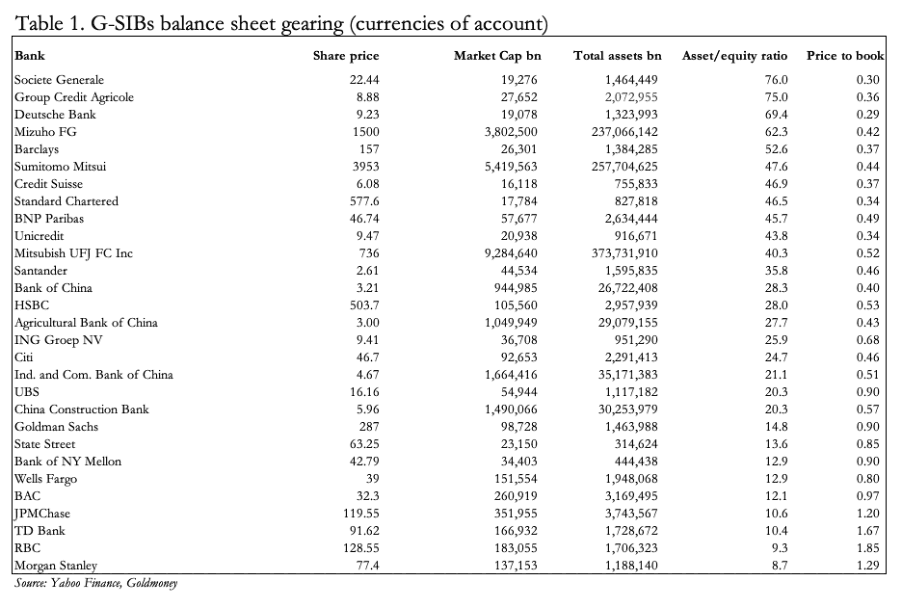
Meanwhile, G-SIBs (GLOBAL SYSTEMYCALLY IMPORTANT BANKS) have asset to common equity ratios often more than fifty times, with some in the eurozone over seventy. It is hardly surprising that most G-SIBs are valued in the equity markets at substantial discounts to book value.

G-SIBs have accumulated excessive exposure to financial assets, both on-balance sheet and as loan collateral. With vicious bear markets now evident and further interest rate rises guaranteed by falling purchasing powers for currencies, the one thing regulators have not allowed for is now happening: like a deepening meteorological low, bank credit is contracting into a perfect storm.

Why are markets crashing?

Contracting bank credit always ends in a crisis of some sort. With a long-term average of ten years, this cycle of bank credit has been exceptionally long in the tooth. Before we even consider the specific factors behind a withdrawal of credit, we can assume that the longer the period of credit expansion that precedes it, the greater the slump in economic activity that follows.

Whenever the dollar slipped, by lowering interest rates instead of raising them the Fed could encourage foreign portfolio buying. Lower interest rates increased flows of currency and credit into financial assets instead of debasing the currency in the non-financial economy.

Thus, the creation of extra bank credit was directed increasingly into financial speculation in bond and equity markets. There were bubbles, such as the dotcoms in the late-1990s and in mortgage financing preceding the financial crisis of 2008/09. Despite these interruptions, the US authorities made sure that global investment flows primarily supported US financial interests.

As markets caught on, interest rates declined to the point where they disappeared altogether. But as Triffin observed, policies to ensure that a currency is available as the world’s reserve are economically destructive in the long run, and the whole trend set in motion from London’s big bang onwards has now concluded with rising interest rates. It amounts to a super cycle of bank credit expansion certain to end more dramatically than a single cycle. Therefore, this bear market and its systemic issues can be expected to be of a greater magnitude than those which followed the dotcoms and the Lehman failure. 

With interest rates so far beneath the rate at which prices are rising, which is mainly the consequence of earlier monetary debasement, losses are now accumulating for all those who bought into the financialisation story and have failed to bail out of it. Top of a hubristic list are the central banks themselves which augmented monetary expansion with the acquisition of substantial bond portfolios through quantitative easing. Those assets are now collapsing in value, wiping out central bank equity many times over. The central banks themselves will need recapitalising before they can tackle the problems of a widespread systemic collapse in the commercial banking network.

How to recapitalise a central bank

The Fed recently admitted that unrealised losses on the bonds on the asset side of its balance sheet stood at $330bn at end-March, which wipes out its balance sheet equity of $50bn more than six times over. Since then, bond yields have risen a further 1%, increasing the deficit to closer to $500bn. But in the Fed’s case, two differences from other central banks should be noted. First, the profile of US Treasury debt is shorter term in average maturity than in other advanced economies with high levels of government debt, confirmed by the Fed’s intention to retain debt to maturity rather than selling it. This means that price volatility is lessened. And secondly, some of the debt is agency debt (Fanny Mae, Ginny Mae, and Freddy Mac) which on early mortgage redemptions distributes payments to mortgage-backed securities holders. In effect, the maturity profile is shortened by these repayments, increasing their yield, and reducing their notional volatility

But the Bank of Japan and the ECB are in an entirely different situation. And so their ability to underwrite their commercial banking networks is extremely impaired.

The G-SIBs’ balance sheets have deteriorated significantly


To see any banks with asset to equity ratios for their ordinary shareholders of more than twenty times, let alone the two French G-SIBs which appear to be over seventy, is simply jaw-dropping.

Of particular concern is the bunching of risk, with the Eurozone’s G-SIB cohort most vulnerable to shocks, closely followed by the three Japanese banks. That banks in these two jurisdictions are the most highly leveraged groups is partly a consequence of negative interest rates. Credit margins have been tightly compressed, and so long as banking regulations are complied with, the management of these banks have been encouraged to maintain profitability by increasing credit leverage.

Furthermore, as discussed below, the European Central Bank and the Bank of Japan themselves will need to be recapitalised if they are to underwrite the losses in the commercial banking sector which are certain to quickly develop as interest rates rise and bank credit contracts.

The ECB’s impossible position

Economic reality and the ECB’s monetary policies have only occasionally had a tangential relationship, with the ECB bullying its way over markets. The falsity of its position is now being exposed.

Clearly, non-performing loans are rapidly becoming an issue. Additionally, energy, food, and escalating producer prices will make the situation far worse in the coming months. The ability of the Eurozone’s banks to survive all these headwinds will be increasingly questioned. The news here is exceedingly grim, with balance sheet common equity to asset ratios in the stratosphere for the Eurozone G-SIBs. Local banks, upon which most of the non-financial burden of Eurozone credit defaults will fall will not be so highly leveraged, being run by sensible local and regional managers in the main. But in the deteriorating conditions the Eurozone now faces, even asset to equity ratios of as little as ten times could prove fatal to a bank’s future.


With respect to their underlying shareholders, the Eurozone’s G-SIBs are the most highly leveraged banking cohort. In the face of rising interest rates and the contraction of bank credit, there can be little doubt that the first G-SIB failures are likely to be among these banks. The ability of the ECB and its network of shareholding national central banks to weather a credit storm will be challenged and almost certainly found wanting.

At the end of 2021, the ECB’s balance sheet showed assets of €8,466bn and share capital of €109bn. That’s a ratio of assets to shareholder capital of 78 times. A high ratio is tolerable for a central bank so long as it sticks to issuing bank notes. But by last December the ECB had also accumulated Eurozone government and other bonds totalling €4,886bn.

Since the year-end, by last Friday the value of these bonds has fallen sharply, as shown in Table 2, of selected 10-year Eurozone government bonds.


But just assuming an average loss of 25% on its bond holdings as of end-December, there is a loss to the ECB’s assets from this source alone of €1,222bn. That’s a valuation write-off of over eleven times the ECB’s capital account.

A recapitalisation of the ECB is due as a matter of urgency before it is called upon along with the relevant national central banks (NCBs — which are similarly insolvent) to undertake the rescue of the Eurozone’s G-SIBs. We can see from their exceptionally high gearing that they are likely to be the first victims of bank credit contraction.

There are no easy options. It is possible to conceive of a systemic failure at the central bank level threatening the existence of the euro itself. Certainly, the foreign exchanges are likely to be brutal in this matter.

Bank of Japan is in deepening trouble

The Bank of Japan has been conducting QE since 2000, and to date has accumulated 80% of the country’s ETFs amounting to 52 trillion yen ($420bn), as well as 538 trillion yen ($3.7 trillion) in bond purchases.It appears that these investments are carried at cost on the BoJ’s balance sheet. The combined losses amount to approximately 14 trillion yen ($104bn) since the year-end compared with balance sheet capital consisting of equity and reserves of 4.7 trillion yen (USD35bn). That’s a rapidly rising ratio of net liabilities to capital of 3:1. 

The Bank of Japan is trying to save itself from further financial embarrassment by ensuring bond yields rise no further. It has drawn a line in the sand for the 10-year JGB yield at 0.25% and has cleaned out the market at this maturity. The price is now in Humpty Dumpty territory: what the BoJ says is the price, is the price.

The cost has been yen weakness, which is now accelerating. Figure 1 shows the chart of the yen priced in US dollars.

However, permitting yen interest rates to rise will lead to further problems for Japan’s commercial banks, which at equity shareholder level are very highly leveraged, as the table below illustrates.

The Bank of England has dug a hole for itself as well

How will the Fed respond to global problems?

a Fed funds rate of1.5%—1.75% is still a long way behind the curve. They are bound to go considerably higher, collapsing bond and financial collateral values. It will lead to a crisis in financial markets. And given that the commercial banks in the Eurozone and Japan possess extremely high shareholder leverage, that can be expected to occur very soon.

Unless the Fed is prepared to let markets sort this mess out — a course of action we can dismiss out of hand — the Fed’s only possible response will be to inflate the dollar to compensate for the contraction of bank credit. The means by which this will be done is not the point. There will be no alternative, as the Fed’s priority will be to save the financial system and to minimise the consequences for the wider American economy and particularly for the Federal Government’s finances. The other central banks mentioned in this article will have to follow suit, where they can. Expect swap lines between them to be expanded to enable them to do so. Expect bond markets to be closed by diktat, perhaps for more than a day or two. As helpless bystanders, we will all be looking into an abyss, fearful that there is no resolution to an unsolvable crisis.

The outturn could be very different, but logic suggests the following. Interest rates will rise until bank failures materialise. Meanwhile, financial assets will have fallen in value, possibly very quickly. Then we can expect monetary policy to expand to rescue the commercial banks, supress bond yields and to finance soaring government deficits.

At this side of the crisis, which is only in its initial stages, the euro is slated as the first currency to collapse entirely, not just because it is a fiat designed by committee, but because of the depth of the structural problems in the ECB and its shareholders.

Will the authorities respond by suppressing prices like latter day Diocletians, banning gold ownership as well? These would be stupid moves, but extremely likely. Gold markets could be simply closed, denying access to those belatedly fleeing fiat.


Saturday, June 11, 2022

EL INFORME DE CONFLICTO DE LA COMISIÓN CONSULTIVA DE 18-05-2022 (IVA)


 La Comisión considera en definitiva que la secuencia de operaciones descritas ha obedecido en exclusiva a una finalidad de orden fiscal, y que se han distorsionado las finalidades que son propias de los negocios jurídicos empleados, de suerte que la intervención artificiosa de la comunidad de bienes, COMUNIDAD DE BIENES (constituida por el médico odontólogo y su esposa sobre unos locales adquiridos en partes iguales), como arrendadora de los locales por un valor inferior al valor de mercado a uno de los comuneros, D. MM, obedece estrictamente a salvar de forma impropia la imposibilidad de éste de deducir y, en última instancia, recuperar las cuotas de IVA soportadas en los gastos y obras realizadas en la clínica dental de D. MM, al tratarse de una actividad exenta de IVA que no genera el derecho a la deducción. 

 La obtención de este ahorro fiscal ha sido el único efecto relevante que deriva de las operaciones realizadas. La artificiosidad de las operaciones, consideradas en su conjunto, la inexistencia de efectos económicos relevantes que justifiquen llevar a cabo las referidas operaciones y el ahorro fiscal alcanzado a través de las mismas permiten concluir que concurren las circunstancias previstas en el artículo 15 de la LGT. 

 Por todo lo cual, y ante la evidencia de los elementos probatorios examinados y las circunstancias concurrentes, esta Comisión consultiva concluye que PROCEDE DECLARAR, con el carácter vinculante que confiere a este informe el artículo 159.6 LGT

Llama la atención que el Informe no considere en modo alguno la aplicación al supuesto del régimen de deducción de actividades diferenciadas en el IVA:

"Artículo 9.

(…)

A efectos de lo dispuesto en esta Ley, se considerarán sectores diferenciados de la actividad empresarial o profesional los siguientes:

a') Aquellos en los que las actividades económicas realizadas y los regímenes de deducción aplicables sean distintos.

Se considerarán actividades económicas distintas aquellas que tengan asignados grupos diferentes en la Clasificación Nacional de Actividades Económicas.

(…)

Los regímenes de deducción a que se refiere esta letra a') se considerarán distintos si los porcentajes de deducción, determinados con arreglo a lo dispuesto en el artículo 104 de esta Ley, que resultarían aplicables en la actividad o actividades distintas de la principal difirieran en más de 50 puntos porcentuales del correspondiente a la citada actividad principal.

La actividad principal, con las actividades accesorias a la misma y las actividades económicas distintas cuyos porcentajes de deducción no difirieran en más 50 puntos porcentuales con el de aquélla constituirán un solo sector diferenciado.

Las actividades distintas de la principal cuyos porcentajes de deducción difirieran en más de 50 puntos porcentuales con el de ésta constituirán otro sector diferenciado del principal.

A los efectos de lo dispuesto en esta letra a'), se considerará principal la actividad en la que se hubiese realizado mayor volumen de operaciones durante el año inmediato anterior.

(…)

Artículo 101. Régimen de deducciones en sectores diferenciados de la actividad empresarial o profesional.

Uno. Los sujetos pasivos que realicen actividades económicas en sectores diferenciados de la actividad empresarial o profesional deberán aplicar separadamente el régimen de deducciones respecto de cada uno de ellos.

La aplicación de la regla de prorrata especial podrá efectuarse independientemente respecto de cada uno de los sectores diferenciados de la actividad empresarial o profesional determinados por aplicación de lo dispuesto en el artículo 9, número 1.º, letra c), letras a'), c') y d') de esta Ley.

Los regímenes de deducción correspondientes a los sectores diferenciados de actividad determinados por aplicación de lo dispuesto en el artículo 9, número 1.º, letra c), letra b') de esta Ley se regirán, en todo caso, por lo previsto en la misma para los regímenes especiales simplificado, de la agricultura, ganadería y pesca, de las operaciones con oro de inversión y del recargo de equivalencia, según corresponda."

La aplicación de un régimen legal previsto especialmente (sectores diferenciados de actividad exenta y actividad sujeta en el IVA), o la consecución de sus efectos propios en el citado impuesto, no debería considerarse como un supuesto del art. 15 de la LGT. 

Un efecto legalmente establecido no puede considerarse notoriamente artificioso o impropio ni un ahorro fiscal indebido (presupuestos del art.15 LGT)


Wednesday, June 1, 2022

SENTENCIA TRIBUNAL SUPREMO 6-04-2022: IMPUESTO SUCESIONES NO RESIDENTES Y DERECHO DE LA UNIÓN


Situación de diferencia de trato discriminatoria entre los residentes y los no residentes (con quebrantamiento del artículo 14 de la CE) en cuanto al régimen de beneficios fiscales previstos para los primeros por razón de residencia, ya que la sentencia del TJUE declara que "(el Reino de España) ha incumplido las obligaciones que le incumben en virtud de los artículos 63 TFUE y 40 del Acuerdo sobre el Espacio Económico Europeo de 2 de mayo de 1992, al permitir que se establezcan diferencias en el trato fiscal de las donaciones y las sucesiones entre los causahabientes y los donatarios residentes y no residentes en España...y las disposiciones similares de bienes inmuebles situados en territorio español y fuera de éste". Como se ha referido, ya hemos aplicado esa jurisprudencia a situaciones en las que se constata una residencia en Estados terceros. Si bien en las citadas sentencias 1.546/2020 de 19 de noviembre y 1.633/2020 de 30 de noviembre quien residía en el Estado tercero era el causante y, en este caso, es causahabiente, dicha circunstancia no obsta para mantener nuestra doctrina a la vista de la propia sentencia del TJUE de 3 de septiembre de 2014 y, en definitiva, a tenor de la aludida dimensión -exterior a la Unión- de la libre circulación de capitales (ex art. 63 TFUE). Esas mismas razones, llevan también a considerar que ningún impedimento existe para proyectar nuestras conclusiones por el hecho de que la autoliquidación, su frustrada rectificación y la inadmisión de la solicitud de nulidad, acaecieran tras el pronunciamiento de la sentencia del TJUE de 3 de septiembre de 2014. Al contrario, dicha circunstancia debe reforzar nuestra posición- debiendo servir, precisamente, para realizar una "interpretación conforme" al derecho de la Unión de la DA 2ª LISD, modificada por la Ley 26/2014, en el sentido de considerar incluidos en la misma a los residentes en Estados terceros. A estos efectos, no se comparte la afirmación del escrito de oposición, relativa a que la contradicción con el derecho de la Unión imputable a la Ley ("la ley de cobertura", según el abogado del Estado) no se haya declarado por el Tribunal de Justicia en sentencia alguna "sino por tribunales internos" pues, a todos los efectos, este Tribunal Supremo, como juez nacional -igual que cualquier órgano judicial de cualquier Estado miembro- puede y debe comprobar la conformidad o adecuación de su norma nacional al derecho de la Unión sin que, además, ello deba comportar, necesariamente, "declaración" alguna, toda vez que la decisión que se adopte en torno a esa conformidad o adecuación, no es sino el resultado de la apreciación especifica que se haga en el caso enjuiciado, dentro de los límites de la doctrina del acto claro (por todas, sentencia del Tribunal de Justicia de 6 de octubre de 2021, Consorzio Italian Management, C-561/19, ECLI: EU:C:2021:799). Pero es que, incluso, dicha obligación recae también sobre la propia Administración que, en cierto modo, al ser llamada en primer término a interpretar y aplicar el ordenamiento jurídico, en la mayor parte de las ocasiones será también la primera en demostrar su fiabilidad en la salvaguarda del derecho de la Unión. En este sentido, como hemos recordado en nuestra sentencia 1336/2021, de 16 de noviembre, rca 2871/2020, ECLI:ES:TS:2021:4371, si la Administración desatendiera dicho compromiso, estaría eludiendo su obligación de conducirse de acuerdo con el principio de legalidad ( artículos 9.1 CE y 103.1 CE, preceptos ambos que deben de leerse -especialmente en este caso-, en íntima conexión con el artículo 93 CE), pues, tal escenario situaría a la Administración en una posición de irresponsabilidad, inaceptable para el Estado de Derecho, uno de los valores en que se fundamenta la Unión ( art. 2 Tratado de la Unión Europea). Pues bien, sobre la particular temática que nos ocupa, la Administración tributaria ha dado buena muestra de ese compromiso -aunque, obviamente, no en este especifico caso- como ilustran las consultas vinculantes anteriormente referidas (V3151-18, de 11 de diciembre; y V3193-18, de 14 de diciembre), que llegan a recoger entre sus conclusiones que "no ha de tenerse en cuenta la exclusión de los países terceros ajenos al EEE en relación con el ámbito de aplicación de la disposición adicional segunda de la Ley 19/1987, de 18 de diciembre, del Impuesto de Sucesiones y Donaciones. Por lo tanto, el régimen regulado en dicha disposición adicional resultará aplicable en relación con todos los no residentes, con independencia de que residan en un Estado miembro de la Unión Europea o del Espacio Económico Europeo o en un país tercero", afirmaciones que resaltan aún más, si cabe, el carácter desfasado de la presente controversia casacional. SEXTO. - Contenido interpretativo de esta sentencia y resolución de las pretensiones deducidas en el proceso Con arreglo a lo que establece el artículo 93.1 LJCA, procede, en función de todo lo razonado precedentemente declarar lo siguiente: "La doctrina del Tribunal de Justicia de la Unión Europea contenida en la sentencia de 3 de septiembre de 2014, Comisión/España (asunto C-127/12; EU:C:2014:2130), resulta de aplicación a quienes no son residentes en la Unión Europea o en el Espacio Económico Europeo, sino en Estados terceros, como Estados Unidos. Dicha doctrina, aunque no constituye, por sí misma, motivo suficiente para declarar la nulidad de cualesquiera actos obliga, no obstante, en presencia de actos firmes, a considerar la invocación de una causa de nulidad de pleno derecho, prevista en la letra a) del apartado 1 del artículo 217 LGT." En consecuencia, la sentencia de apelación debe ser casada y anulada por resultar contraria a la doctrina expresada. En efecto, teniendo en consideración que, en este caso el acto frente al que se dirigió la solicitud de la nulidad de pleno derecho del artículo 217 LGT era firme; que la inadmisión apreció una carencia manifiesta de fundamento; y, que ese rechazo se contestó exhibiendo, precisamente, los sólidos fundamentos de la solicitud de la nulidad de pleno derecho, invocando la causa de la letra a) del apartado 1 de ese precepto, consideramos que los jueces de apelación debieron entrar a analizar la verdadera controversia del asunto, esto es, la procedencia o no de la rectificación de la autoliquidación, rectificación que, en este caso, presentaba, además, una clara dimensión de garantía del derecho de la Unión y que, adicionalmente, les obligaba a alcanzar la interpretación más favorable para salvaguardar la eficaz y correcta aplicación de sus determinaciones. Ahora bien, por exigencias del principio dispositivo, la estimación del recurso de apelación debe llevar consigo -al peticionarlo así la representación de doña Marcelina -, que declaremos su derecho a que sea admitida a trámite su solicitud de nulidad de pleno derecho contra la denegación de la rectificación de su autoliquidación por el impuesto sobre sucesiones, a cuyo efecto, se ordena retrotraer las actuaciones al momento anterior a dictarse la resolución de 23 de mayo de 2017 a fin de que la Administración tramite y resuelva ese procedimiento de nulidad de pleno derecho, con la máxima celeridad y con específica consideración a nuestra jurisprudencia

Wednesday, May 25, 2022

STAGFLATION 2.0 (II)

STAGFLATION 2.0 (I)

Wednesday, May 18, 2022

LA FED (USA) EN DOS GRÁFICOS ATEMORIZADORES (II)

As of December 31 of last year, just six bank holding companies (out of a total of 4,839 federally-insured) hold $13.699 trillion or 61 percent of all assets of all commercial banks.That is the most dangerous concentration of risk in the history of federally-insured banking Those are the same six bank holding companies that control 89 percent of the $234 trillion in derivatives that have a habit of blowing up during every Fed rate-hiking cycle.

LA FED (USA) EN DOS GRÁFICOS ATEMORIZADORES (I)

Tuesday, May 17, 2022

TJUE (C-570/20): LA RAZONABLE PREVISIBILIDAD DE PROCEDIMIENTO PENAL POR EVASIÓN TRIBUTARIA

 SENTENCIA DEL TRIBUNAL DE JUSTICIA (Sala Primera)

de 5 de mayo de 2022 (*)

«Procedimiento prejudicial — Impuesto sobre el valor añadido (IVA) — Directiva 2006/112/CE — Ocultación fraudulenta del impuesto devengado — Sanciones — Legislación nacional que prevé una sanción administrativa y una sanción penal por los mismos hechos — Carta de los Derechos Fundamentales de la Unión Europea — Artículo 49 — Artículo 50 — Principio non bis in idem — Artículo 52, apartado 1 — Limitaciones del principio non bis in idem — Exigencia de establecer normas claras y precisas — Posibilidad de tener en cuenta la interpretación de la legislación nacional por los órganos jurisdiccionales nacionales — Necesidad de establecer normas que garanticen la proporcionalidad del conjunto de sanciones impuestas — Sanciones de distinta naturaleza»

En el asunto C‑570/20,

que tiene por objeto una petición de decisión prejudicial planteada, con arreglo al artículo 267 TFUE, por la Cour de cassation (Tribunal de Casación, Francia), mediante resolución de 21 de octubre de 2020, recibida en el Tribunal de Justicia el 28 de octubre de 2020, en el procedimiento penal contra

BV,

con intervención de:

Direction départementale des finances publiques de la Haute‑Savoie,


(...)

Sobre las cuestiones prejudiciales

25      Mediante sus dos cuestiones prejudiciales, que procede examinar conjuntamente, el órgano jurisdiccional remitente desea saber, en esencia, si el derecho fundamental garantizado en el artículo 50 de la Carta, en relación con el artículo 52, apartado 1, de esta, debe interpretarse en el sentido de que se opone

–        a que la limitación de la acumulación de procedimientos y de sanciones de carácter penal en caso de ocultaciones fraudulentas o de omisiones declarativas en materia de IVA que prevé una normativa nacional en los casos más graves resulte únicamente de una jurisprudencia consolidada que interprete, de manera restrictiva, las disposiciones legales que definen los requisitos para la aplicación de dicha acumulación, y/o

–        a una normativa nacional que no garantice, en los casos de acumulación de una sanción pecuniaria y de una pena privativa de libertad, mediante normas claras y precisas, en su caso tal y como han sido interpretadas por los órganos jurisdiccionales nacionales, que el conjunto de las sanciones impuestas no exceda de la gravedad de la infracción constatada.

26      Con carácter preliminar, es preciso recordar que, según reiterada jurisprudencia, las sanciones administrativas impuestas por las autoridades tributarias nacionales y los procesos penales incoados por infracciones en materia de IVA constituyen una aplicación de los artículos 2 y 273 de la Directiva 2006/112 y del artículo 325 TFUE y, por tanto, del Derecho de la Unión en el sentido del artículo 51, apartado 1, de la Carta, y, por consiguiente, deben respetar el derecho fundamental garantizado en el artículo 50 de esta última (sentencia de 20 de marzo de 2018, Menci, C‑524/15, EU:C:2018:197, apartado 21 y jurisprudencia citada).

27      A tenor de esta disposición, nadie podrá ser juzgado o condenado penalmente por una infracción respecto de la cual ya haya sido absuelto o condenado en la Unión mediante sentencia penal firme conforme a la ley.

28      En el caso de autos, en el marco del procedimiento penal de que se trata en el litigio principal, BV está acusado de actos de ocultación fraudulenta y de omisiones declarativas en materia de IVA, siendo así que, según las indicaciones que figuran en la petición de decisión prejudicial, ya se le ha impuesto, por los mismos hechos, una sanción administrativa firme, de carácter penal en el sentido del artículo 50 de la Carta. Pues bien, tal acumulación de procedimientos constituye una limitación del derecho fundamental consagrado por la mencionada disposición de la Carta, ya que esta prohíbe imponer, por hechos idénticos, varias sanciones de carácter penal al término de distintos procedimientos tramitados a estos efectos (véase, por analogía, la sentencia de 20 de marzo de 2018, Menci, C‑524/15, EU:C:2018:197, apartado 35).

29      No obstante, según reiterada jurisprudencia, una limitación del derecho fundamental garantizado en el artículo 50 de la Carta puede justificarse sobre la base del artículo 52, apartado 1, de esta (sentencias de 20 de marzo de 2018, Menci, C‑524/15, EU:C:2018:197, apartado 40 y jurisprudencia citada, y de 22 de marzo de 2022, Nordzucker y otros, C‑151/20, EU:C:2022:203, apartado 49).

30      Conforme al artículo 52, apartado 1, primera frase, de la Carta, cualquier limitación del ejercicio de los derechos y libertades reconocidos por esta deberá ser establecida por la ley y respetar el contenido esencial de dichos derechos y libertades. Según la segunda frase de ese mismo apartado, dentro del respeto del principio de proporcionalidad, solo podrán introducirse limitaciones de esos derechos y libertades cuando sean necesarias y respondan efectivamente a objetivos de interés general reconocidos por la Unión o a la necesidad de protección de los derechos y libertades de los demás.

31      En el caso de autos, en primer lugar, consta que la posibilidad de acumular procedimientos y sanciones penales y procedimientos y sanciones administrativas de carácter penal está prevista por la ley, a saber, por los artículos 1729 y 1741 del CGI. Si bien la exigencia de que toda limitación del ejercicio de los derechos fundamentales debe estar prevista por la ley implica que la base legal que permita la injerencia en estos derechos debe definir ella misma el alcance de la limitación del ejercicio del derecho de que se trate, tal exigencia se confunde ampliamente con las exigencias de claridad y de precisión derivadas del principio de proporcionalidad (véase, en este sentido, la sentencia de 16 de julio de 2020, Facebook Ireland y Schrems, C‑311/18, EU:C:2020:559, apartado 180), que se examinará en los apartados 34 y siguientes de la presente sentencia.

32      En segundo lugar, una normativa nacional como la que es objeto del litigio principal respeta el contenido esencial del derecho fundamental garantizado en el artículo 50 de la Carta, ya que, según se indica en los autos que obran en poder del Tribunal de Justicia, únicamente permite tal acumulación de procedimientos y de sanciones en condiciones definidas taxativamente, garantizando así que el derecho reconocido en ese artículo 50 no se ponga en cuestión como tal.

33      En tercer lugar, de los autos que obran en poder del Tribunal de Justicia se desprende que esa normativa tiene por objeto garantizar la percepción íntegra del IVA devengado. Habida cuenta de la importancia que la jurisprudencia del Tribunal de Justicia concede, para alcanzar dicho objetivo, a la lucha contra las infracciones en materia de IVA, la limitación del principio non bis in idem resultante de una normativa nacional como la controvertida en el litigio principal responde a un objetivo de interés general.

34      En lo referente, en cuarto lugar, al principio de proporcionalidad, este exige que la acumulación de procedimientos y sanciones prevista por una normativa nacional como la controvertida en el litigio principal no exceda los límites de lo que sea adecuado y necesario para la consecución de los objetivos legítimamente perseguidos por dicha normativa, entendiéndose que, cuando se ofrezca una elección entre varias medidas adecuadas, deberá recurrirse a la menos onerosa y que las desventajas ocasionadas por esta no deben ser desproporcionadas con respecto a los objetivos perseguidos (sentencia de 20 de marzo de 2018, Menci, C‑524/15, EU:C:2018:197, apartado 46 y jurisprudencia citada).

35      Una normativa nacional que prevé la posibilidad de tal acumulación de procedimientos y de sanciones es adecuada para alcanzar el objetivo legítimo de luchar contra las infracciones en materia de IVA con el fin de garantizar la percepción íntegra del IVA devengado (sentencia de 20 de marzo de 2018, Menci, C‑524/15, EU:C:2018:197, apartado 48).

36      Por lo que respecta al carácter estrictamente necesario de tal normativa nacional, el Tribunal de Justicia precisó, en los apartados 49, 53 y 55 de la sentencia de 20 de marzo de 2018, Menci (C‑524/15, EU:C:2018:197), que esta debe establecer normas claras y precisas que, antes de nada, permitan al justiciable determinar qué actos y omisiones pueden ser objeto de tal acumulación de procedimientos y de sanciones, que garanticen además una coordinación de los procedimientos con el fin de reducir a lo estrictamente necesario la carga adicional que supone la acumulación de procedimientos de carácter penal que se desarrollan de manera independiente y que, por último, permitan garantizar que la gravedad del conjunto de las sanciones impuestas corresponde a la gravedad de la infracción en cuestión.

37      El órgano jurisdiccional remitente se pregunta, en primer lugar, sobre la primera de las exigencias recordadas en el apartado anterior, la cual, por lo que respecta al derecho fundamental garantizado en el artículo 50 de la Carta, refleja también el principio de legalidad de los delitos y las penas consagrado en el artículo 49, apartado 1, de la Carta. En efecto, tal como señaló el Abogado General en los puntos 56 a 58 de sus conclusiones, este último principio es aplicable a la acumulación de una sanción administrativa firme de carácter penal, en el sentido del artículo 50 de la Carta, y de un procedimiento penal, en la medida en que esa acumulación puede dar lugar a una consecuencia más grave para la persona afectada que la resultante únicamente de los procedimientos penales. En particular, la carga represiva que resulta de la acumulación de sanciones de carácter penal puede ir más allá de la prevista por la ley por un comportamiento imputado, razón por la cual es necesario que toda disposición que autorice una doble represión respete las exigencias del principio de legalidad de los delitos y las penas garantizado en el artículo 49, apartado 1, de la Carta.

38      Pues bien, en lo que atañe al principio de legalidad de los delitos y las penas, el Tribunal de Justicia ha declarado que, si bien este principio exige que la ley defina claramente los tipos delictivos y las penas que llevan aparejadas, este requisito se cumple cuando el justiciable puede saber, a partir del texto de la disposición pertinente y, si fuera necesario, con ayuda de la interpretación que de ella hacen los tribunales, qué actos y omisiones generan su responsabilidad penal (sentencias de 22 de octubre de 2015, AC-Treuhand/Comisión, C‑194/14 P, EU:C:2015:717, apartado 40 y jurisprudencia citada, y de 11 de junio de 2020, Prokuratura Rejonowa w Słupsku, C‑634/18, EU:C:2020:455, apartado 49).

39      Así, el hecho de que los requisitos exigidos para la acumulación de procedimientos y de sanciones de carácter penal no deriven exclusivamente de disposiciones legislativas, sino también de su interpretación por los órganos jurisdiccionales nacionales no puede, por sí solo, poner en entredicho el carácter claro y preciso de la normativa nacional, siempre que el justiciable pueda saber, a partir del texto de las disposiciones pertinentes y, si fuera necesario, con ayuda de la interpretación que de ellas hagan dichos órganos jurisdiccionales, qué actos y omisiones pueden dar lugar a tal acumulación de procedimientos y de sanciones.

40      Por lo que se refiere a la utilización, por el legislador nacional, de conceptos generales para determinar las actuaciones que pueden dar lugar a una acumulación de procedimientos y de sanciones de carácter penal, procede recordar que, en los apartados 52 y 53 de su sentencia de 20 de marzo de 2018, Garlsson Real Estate y otros (C‑537/16, EU:C:2018:193), el Tribunal de Justicia consideró que la normativa nacional controvertida en el asunto que dio lugar a esa sentencia era suficientemente clara y precisa, aunque dicha normativa nacional hiciera depender esa acumulación de si las actuaciones en cuestión podían causar «una sensible alteración» del precio de los instrumentos financieros y, por tanto, de la interpretación de un concepto general que requiere una apreciación significativa por parte de los órganos jurisdiccionales nacionales.

41      En efecto, de la jurisprudencia relativa al principio de legalidad de los delitos y las penas se desprende que este principio no puede interpretarse en el sentido de que prohíba la aclaración progresiva de las reglas de la responsabilidad penal de un asunto a otro, siempre que el resultado fuera razonablemente previsible en el momento en que se cometió la infracción, en particular habida cuenta de la interpretación que la jurisprudencia daba en aquel momento a la disposición legal examinada (sentencias de 22 de octubre de 2015, AC-Treuhand/Comisión, C‑194/14 P, EU:C:2015:717, apartado 41 y jurisprudencia citada, y de 11 de junio de 2020, Prokuratura Rejonowa w Słupsku, C‑634/18, EU:C:2020:455, apartado 50).

42      Así, y siempre que concurran las mismas condiciones, la circunstancia de que la jurisprudencia nacional se refiera, en el marco de su interpretación de las disposiciones legales pertinentes, a conceptos generales que deben aclararse gradualmente, no impide, en principio, que pueda considerarse que la normativa nacional establece normas claras y precisas que permitan al justiciable prever qué actos y omisiones pueden ser objeto de una acumulación de procedimientos y de sanciones de carácter penal.

43      En este contexto, procede recordar además que el alcance de la previsibilidad así exigida depende en gran medida del contenido del texto de que se trate, del ámbito que cubra y del número y condición de sus destinatarios. La previsibilidad de la ley no es incompatible con el hecho de que la persona afectada se vea obligada a recurrir a un asesoramiento jurídico apropiado para valorar las eventuales consecuencias de un determinado acto en una medida razonable, dadas las circunstancias del caso. Ello resulta especialmente cierto en el caso de los profesionales, habituados a la necesidad de mostrar una gran prudencia en el ejercicio de sus actividades. Cabe por tanto esperar de estos que presten especial atención a la valoración de los riesgos que entraña dicho ejercicio (véanse, en este sentido, las sentencias de 28 de junio de 2005, Dansk Rørindustri y otros/Comisión, C‑189/02 P, C‑202/02 P, C‑205/02 P a C‑208/02 P y C‑213/02 P, EU:C:2005:408, apartado 219 y jurisprudencia citada; de 22 de octubre de 2015, AC-Treuhand/Comisión, C‑194/14 P, EU:C:2015:717, apartado 42, y de 28 de marzo de 2017, Rosneft, C‑72/15, EU:C:2017:236, apartado 166).

44      En el caso de autos, si bien incumbe al órgano jurisdiccional remitente comprobar si la normativa nacional controvertida en el litigio principal respeta las exigencias de claridad y precisión recordadas en el apartado 36 de la presente sentencia, corresponde al Tribunal de Justicia proporcionar indicaciones útiles a este respecto para permitirle resolver el litigio del que conoce [véase, por analogía, la sentencia de 22 de junio de 2021, Staatssecretaris van Justitie en Veiligheid (Efectos de una decisión de expulsión), C‑719/19, EU:C:2021:506, apartado 82 y jurisprudencia citada].

45      Pues bien, antes de nada, de las indicaciones que figuran en la petición de decisión prejudicial se desprende que el artículo 1729 del CGI establece las condiciones en las que las ocultaciones fraudulentas o las omisiones declarativas en materia de IVA pueden dar lugar a la imposición de una sanción administrativa pecuniaria de carácter penal. Con arreglo al artículo 1741 del CGI y en las condiciones previstas en dicha disposición, tales actos pueden también ser objeto, «con independencia de las sanciones fiscales aplicables», de una multa penal y de una pena privativa de libertad.

46      A continuación, el Conseil constitutionnel (Consejo Constitucional) ha declarado que la acumulación de procedimientos y de sanciones que prevén estos artículos solo puede aplicarse en los casos más graves de ocultación fraudulenta de cantidades sujetas al impuesto o de omisiones declarativas, precisando al mismo tiempo que esta gravedad puede resultar del importe de los derechos defraudados, de la naturaleza de las actuaciones del acusado o de las circunstancias de su intervención. Pues bien, sin perjuicio de la apreciación del órgano jurisdiccional remitente, tal interpretación realizada por dicho órgano jurisdiccional a la luz del principio de proporcionalidad no resulta, en sí misma, imprevisible.

47      Por último, el órgano jurisdiccional remitente señala que ya ha aplicado en varias ocasiones la jurisprudencia del Conseil constitutionnel (Consejo Constitucional) contemplada en el apartado anterior y, de este modo, ha precisado más su alcance. Corresponde al órgano jurisdiccional remitente comprobar si, habida cuenta de estos precedentes jurisprudenciales, era razonablemente previsible para BV, en el momento en que se cometieron los hechos controvertidos en el litigio principal, que estos pudieran dar lugar a una acumulación de procedimientos y de sanciones de carácter penal con arreglo a los artículos 1729 y 1741 del CGI.

48      En este contexto, el hecho de que BV hubiera debido, en su caso, recurrir a la asistencia de un asesor jurídico para evaluar las consecuencias que pudieran derivarse de los hechos que se le imputaban a la luz de los requisitos para la aplicación de la acumulación de procedimientos y de sanciones de carácter penal que prevén dichos artículos, tal como han sido interpretados por los órganos jurisdiccionales nacionales, no puede, conforme a la jurisprudencia recordada en el apartado 43 de la presente sentencia, cuestionar el carácter claro y preciso de la normativa nacional controvertida en el litigio principal. Ello es tanto más cierto en el caso de BV en la medida en que este parece haber cometido esos hechos en el marco de su actividad profesional de auditor.

49      En segundo lugar, el órgano jurisdiccional remitente se pregunta sobre la tercera exigencia contemplada en el apartado 36 de la presente sentencia, derivada tanto del artículo 52, apartado 1, de la Carta como del principio de proporcionalidad de las penas consagrado en el artículo 49, apartado 3, de esta, que implica para las autoridades competentes la obligación, en caso de imponer una segunda sanción, de velar por que la gravedad del conjunto de las sanciones impuestas no exceda de la gravedad de la infracción constatada (véase, en este sentido, la sentencia de 20 de marzo de 2018, Garlsson Real Estate y otros, C‑537/16, EU:C:2018:193, apartado 56).

50      A este respecto, se debe precisar que, según la jurisprudencia recordada en el apartado 36 y en el apartado anterior de la presente sentencia, esta exigencia se aplica, sin excepción, a todas las sanciones impuestas acumulativamente y, por consiguiente, tanto a la acumulación de sanciones de la misma naturaleza como a la acumulación de sanciones de distinta naturaleza, como es la acumulación de sanciones pecuniarias y de penas privativas de libertad. El mero hecho de que las autoridades competentes tengan la intención de imponer sanciones de distinta naturaleza no puede eximirlas de la obligación de asegurarse de que la gravedad del conjunto de las sanciones impuestas no exceda de la gravedad de la infracción constatada, so pena de vulnerar el principio de proporcionalidad.

51      En estas circunstancias, el Tribunal de Justicia declaró, en el apartado 60 de la sentencia de 20 de marzo de 2018, Garlsson Real Estate y otros (C‑537/16, EU:C:2018:193), que esa exigencia de proporcionalidad no es respetada por una normativa que establece, para la acumulación de una multa penal y de una sanción administrativa pecuniaria de carácter penal, que el cobro de la primera se limitará a la parte que sobrepase el importe de la segunda, sin establecer tal norma también para la acumulación de una sanción administrativa pecuniaria de carácter penal y de una pena privativa de libertad.

52      En el caso de autos, si bien, conforme a las indicaciones que figuran en la petición de decisión prejudicial, el órgano jurisdiccional remitente ya ha declarado, basándose en consideraciones de proporcionalidad, que el importe total de una sanción impuesta en caso de acumulación de sanciones no debe superar el importe más elevado de una de las sanciones impuestas, ese mismo órgano jurisdiccional ha precisado que dicha limitación solo se aplica a sanciones de la misma naturaleza, a saber, a sanciones pecuniarias. Pues bien, como señaló el Abogado General en el punto 103 de sus conclusiones, tal limitación no garantiza la correspondencia entre la gravedad de la infracción y la gravedad del conjunto de las sanciones impuestas cuando se acumula una sanción pecuniaria con una pena privativa de libertad.

53      En la medida en que el Gobierno francés ha señalado ante el Tribunal de Justicia que el juez penal está obligado a respetar el principio de proporcionalidad de las penas que le confiere la facultad de modular la sanción penal en función de las circunstancias del caso concreto, de la jurisprudencia recordada en los apartados 36 y 49 de la presente sentencia se desprende, por una parte, que las autoridades competentes tienen la obligación de velar por que la gravedad del conjunto de las sanciones impuestas no exceda de la gravedad de la infracción constatada y, por otra parte, que dicha obligación debe resultar, de manera clara y precisa, de la normativa nacional en cuestión.

54      Corresponde al órgano jurisdiccional remitente comprobar si sucede así en el caso de autos, teniendo en cuenta que ha declarado, basándose igualmente en consideraciones de proporcionalidad, que la limitación contemplada en el apartado 52 solo resulta aplicable a la acumulación de sanciones de la misma naturaleza.

55      En atención a las consideraciones anteriores, procede responder a las cuestiones prejudiciales que el derecho fundamental garantizado en el artículo 50 de la Carta, en relación con el artículo 52, apartado 1, de esta, debe interpretarse en el sentido de que

–        no se opone a que la limitación de la acumulación de procedimientos y de sanciones de carácter penal en caso de ocultaciones fraudulentas o de omisiones declarativas en materia de IVA que prevé una normativa nacional en los casos más graves resulte únicamente de una jurisprudencia consolidada que interprete, de manera restrictiva, las disposiciones legales que definen los requisitos para la aplicación de dicha acumulación, siempre que sea razonablemente previsible, en el momento en que se comete la infracción, que esta puede ser objeto de una acumulación de procedimientos y de sanciones de carácter penal, pero

–        se opone a una normativa nacional que no garantiza, en los casos de acumulación de una sanción pecuniaria y de una pena privativa de libertad, mediante normas claras y precisas, en su caso tal y como han sido interpretadas por los órganos jurisdiccionales nacionales, que el conjunto de las sanciones impuestas no exceda de la gravedad de la infracción constatada.

 Costas

56      Dado que el procedimiento tiene, para las partes del litigio principal, el carácter de un incidente promovido ante el órgano jurisdiccional nacional, corresponde a este resolver sobre las costas. Los gastos efectuados por quienes, no siendo partes del litigio principal, han presentado observaciones ante el Tribunal de Justicia no pueden ser objeto de reembolso.

En virtud de todo lo expuesto, el Tribunal de Justicia (Sala Primera) declara:

El derecho fundamental garantizado en el artículo 50 de la Carta de los Derechos Fundamentales de la Unión Europea, en relación con el artículo 52, apartado 1, de esta, debe interpretarse en el sentido de que

–        no se opone a que la limitación de la acumulación de procedimientos y de sanciones de carácter penal en caso de ocultaciones fraudulentas o de omisiones declarativas en materia de impuesto sobre el valor añadido (IVA) que prevé una normativa nacional en los casos más graves resulte únicamente de una jurisprudencia consolidada que interprete, de manera restrictiva, las disposiciones legales que definen los requisitos para la aplicación de dicha acumulación, siempre que sea razonablemente previsible, en el momento en que se comete la infracción, que esta puede ser objeto de una acumulación de procedimientos y de sanciones de carácter penal, pero

–        se opone a una normativa nacional que no garantiza, en los casos de acumulación de una sanción pecuniaria y de una pena privativa de libertad, mediante normas claras y precisas, en su caso tal y como han sido interpretadas por los órganos jurisdiccionales nacionales, que el conjunto de las sanciones impuestas no exceda de la gravedad de la infracción constatada.

Saturday, May 7, 2022

EL TRIBUNAL SUPREMO DE LA INDIA Y LAS OBLIGACIONES DE VACUNACIÓN COVID (II)

EL TRIBUNAL SUPREMO DE LA INDIA Y LAS OBLIGACIONES DE VACUNACIÓN COVID (I)

On May 2, in a landmark judgment, India’s Supreme Court, the highest court in the land, ruled that “no one can be forced to be vaccinated” and that “bodily integrity and personal autonomy” are protected under the law as a constitutional right. Citing emerging scientific opinion “which appears to indicate that the risk of transmission of the virus from unvaccinated individuals is almost on par with that from vaccinated persons,” the judicial bench went on to argue that since infection rates are currently low, restrictions imposed on the unvaccinated, including those that curtail their freedom of movement and access to welfare and other services, are not “proportionate,” and urged organizations that imposed these restrictions to review these measures and modify them as necessary.

The court was responding to a plea filed by a former member of the country’s national advisory group on immunization, seeking disclosure on vaccine clinical trials and the posting of vaccination-adverse events data. The plea argued that Indian states’ legislation mandating vaccination for government employees and as a precondition for accessing welfare and other services, including travel in public transport, was a violation of basic individual rights and, therefore, unconstitutional.

The federal government in India itself has not issued any vaccine mandates and has always maintained that it is a voluntary, individual choice. The judgment was rendered even more extraordinary by the fact the directives were limited to the “present situation alone,” and the court upheld government restrictions on the unvaccinated “if the situation so warrants,” thereby striking a delicate balance between a person’s right to choose and the government’s responsibility in protecting public health.


What is fascinating is that this extraordinary Supreme Court judgment in India is in the context of a Westminster system, a system originating in the United Kingdom but also, of course, shared by Canada. Unlike in the United States, with its tradition of activist courts that are not shy to push back against the executive or legislature, and are highly protective of constitutionally enshrined civil liberties, the Indian judicial system, like the British and Canadian systems, tends to exhibit a culture of deference to Parliament.

Monday, May 2, 2022

CUESTIÓN DE CONSTITUCIONALIDAD ITALIANA OBLIGACIONES DE VACUNACIÓN (II)

CUESTIÓN DE CONSTITUCIONALIDAD ITALIANA OBLIGACIONES DE VACUNACIÓN (I)

Il Consiglio di Giustizia Amministrativa per la Regione Siciliana, in sede giurisdizionale, - visto l’art. 23 l. 11 marzo 1953 n. 87, dichiara rilevante e non manifestamente infondata la questione di legittimità costituzionale:

 a) dell’art. 4, commi 1 e 2, del d.l. n. 44/2021 (convertito in l. n. 76/2021), nella parte in cui prevede, da un lato l’obbligo vaccinale per il personale sanitario e, dall’altro lato, per effetto dell’inadempimento all’obbligo vaccinale, la sospensione dall’esercizio delle professioni sanitarie, per contrasto con gli artt. 3, 4, 32, 33, 34, 97 della Costituzione, sotto il profilo che il numero di eventi avversi, la inadeguatezza della farmacovigilanza passiva e attiva, il mancato coinvolgimento dei medici di famiglia nel triage pre-vaccinale e comunque la mancanza nella fase di triage di approfonditi accertamenti e persino di test di positività/negatività al Covid non consentono di ritenere soddisfatta, allo stadio attuale di sviluppo dei vaccini antiCovid e delle evidenze scientifiche, la condizione, posta dalla Corte costituzionale, di legittimità di un vaccino obbligatorio solo se, tra l’altro, si prevede che esso non incida negativamente sullo stato di salute di colui che è obbligato, salvo che per quelle sole conseguenze “che appaiano normali e, pertanto, tollerabili”;

 b) dell’art.1 della l. 217/2019, nella parte in cui non prevede l’espressa esclusione dalla sottoscrizione del consenso informato delle ipotesi di trattamenti sanitari obbligatori, e dell’art. 4, del d.l. n. 44/2021, nella parte cui non esclude l’onere di sottoscrizione del consenso informato nel caso di vaccinazione obbligatoria, per contrasto con gli artt. 3 e 21 della Costituzione; - sospende il presente giudizio ai sensi dell’art. 79 comma 1 c.p.a.; - dispone, a cura della Segreteria del C.G.A.R.S., l’immediata trasmissione degli atti alla Corte costituzionale; - rinvia ogni ulteriore statuizione in rito, nel merito e sulle spese di lite all’esito del giudizio incidentale promosso con la presente ordinanza. Ordina che la presente ordinanza sia notificata, a cura della Segreteria del C.G.A.R.S., a tutte le parti in causa, e che sia comunicata al Presidente del Consiglio dei ministri, al Presidente del Senato della Repubblica ed al Presidente della Camera dei deputati. Ritenuto che sussistano i presupposti di cui di cui all'art. 52, commi 1 e 2, del decreto legislativo 30 giugno 2003, n. 196, e all'art. 9, paragrafi 1 e 4, del Regolamento (UE) 2016/679 del Parlamento europeo e del Consiglio del 27 aprile 2016 e all’art. 2-septies del decreto legislativo 30 giugno 2003, n. 196, come modificato dal d.lgs. 10 agosto 2018, n. 101, manda alla Segreteria di procedere, in qualsiasi ipotesi di diffusione del presente provvedimento, all'oscuramento delle SOLE GENERALITÀ dell’appellante e degli intervenienti (ad eccezione di ANIEF). 

Così deciso in Palermo nella camera di consiglio del giorno 16 marzo 2022 con l'intervento dei magistrati: Rosanna De Nictolis, Presidente Marco Buricelli, Consigliere Maria Stella Boscarino, Consigliere, Estensore Giovanni Ardizzone, Consigliere Antonino Caleca, Consigliere